
Theories of Everything with Curt Jaimungal
Theories of Everything with Curt Jaimungal explores theoretical physics, consciousness, AI, and God in a technically rigorous manner. Host Curt Jaimungal, a Torontonian with a degree in mathematical physics from the University of Toronto, analyzes various Theories of Everything from an analytic perspective, increasingly opening up to alternative approaches. The podcast focuses on depth, delving into subjects with academic intensity and embracing unconventional ideas to conduct research rather than merely conveying existing information.
Episodes
She Says Spacetime Points Are Just Where Fields Meet
SPONSORS:
- Visit https://mod.com for a free consultation and get 10% off your first order PLUS free shipping with promo code TOE
- One thing to pack, five ways to power! Get 10% Off @Ridge with code CURT at https://www.Ridge.com/CURT #ridgepod
- Take Cheers Restore after your last drink or before going to bed and wake up feeling at least 50% better — or your money back. For a limited time our li
Tanya Luhrmann: The Experience Is Real. But Is God?
SPONSORS:
- Nobody likes a call center — ElevenAgents by ElevenLabs fixes that with voice AI that sounds human and works 24/7 in 30+ languages. Try it: https://elevenlabs.io/TOE
- Don’t sleep on [@ultrapouches]. New customers get 15% Off with code TOE at http://takeultra.com! #UltraPouches #ad
- I personally subscribe to The Economist. TOE listeners get 35% off the annual subscription. No other po
Tim Maudlin: Quantum Nonlocality Explained FROM SCRATCH
SPONSORS:
- Go to https://www.plaud.ai/curt and use the promo code "CURT" to get a Plaud device today
- Visit https://mod.com for a free consultation and get 10% off your first order PLUS free shipping with promo code TOE.
- I personally subscribe to The Economist. TOE listeners get 35% off the annual subscription. No other podcast has this! https://economist.com/TOE
This is Part Two of the prev
Adrian Owen: Awake. Aware. Unable to Move.
SPONSORS:
- Visit https://mod.com for a free consultation and get 10% off your first order PLUS free shipping with promo code TOE.
- I personally subscribe to The Economist. TOE listeners get 35% off the annual subscription. No other podcast has this! https://economist.com/TOE
There are three questions people ask about consciousness: what it is, how to explain it, and how to measure it. This epi
Peter Godfrey-Smith: This Scientist Found Earth’s “Alien” Minds
SPONSORS:
- Take Cheers Restore after your last drink or before going to bed and wake up feeling at least 50% better — or your money back. For a limited time our listeners are getting 20% off their entire order at https://cheershealth.com/TOE
- I personally subscribe to The Economist. TOE listeners get 35% off the annual subscription. No other podcast has this! https://economist.com/TOE
Peter God
Jacob Tsimerman: He Won Math's Highest Prize. Then Announced the End
I personally subscribe to The Economist. TOE listeners get 35% off the annual subscription. No other podcast has this! https://economist.com/TOE
Ten days after winning the Fields Medal — math's highest honor — Jacob Tsimerman joins to explain why he's leaving academia temporarily for OpenAI's AI safety team, and why he's grieving even as he does it. The conversation covers why math is one of the
Becca Tarnas: Did Jung and Tolkien Enter the Same World?
SPONSORS:
- Nobody likes a call center — ElevenAgents by ElevenLabs fixes that with voice AI that sounds human and works 24/7 in 30+ languages. Try it: elevenlabs.io/TOE
- I personally subscribe to The Economist. TOE listeners get 35% off the annual subscription. No other podcast has this! https://economist.com/TOE
This podcast explores the uncanny link between two of the twentieth century's grea
Tim Maudlin: Quantum Mechanics Explained FROM SCRATCH
I personally subscribe to The Economist. TOE listeners get 35% off the annual subscription. No other podcast has this! https://economist.com/TOE
This is a careful lecture that can be followed with zero background knowledge. Einstein thought he'd caught quantum mechanics in an act of spookiness — this podcast asks whether he was even worried about the right thing. Tim Maudlin, professor of philoso
Emily Adlam & David Wallace: The Quantum Interpretation That Divides Physicists
SPONSORS:
- Go to https://www.plaud.ai/curt and use the promo code "CURT" to get a Plaud device today
- I personally subscribe to The Economist. TOE listeners get 35% off the annual subscription. No other podcast has this! https://economist.com/TOE
This is a podcast all about parallel universes, and whether we have any right to believe in them. David Wallace, professor of philosophy of science at
Ginestra Bianconi: The Physicist Who (Unexpectedly) Derived Gravity From Entropy
I personally subscribe to The Economist. TOE listeners get 35% off the annual subscription. No other podcast has this! https://economist.com/TOE
Ginestra Bianconi thinks gravity can be derived from entropy — and that gravity itself is fundamentally anti-reductionistic, since it's about geometry rather than isolated particle interactions. In this episode, the network-topologist-turned-gravity-theo
Curt Jaimungal: Reality Is Bloody Terrifying
What does it mean to investigate the "nature of reality"? In this episode, we break down the term across philosophy, physics, mathematics, cognitive science, and theology: exploring questions of metaphysics, fundamentality, reductionism, and grounding. We also touch on a conversation with Slavoj Žižek and why the question of why the universe follows laws at all may be the deepest question of all.
Philip Mannheim: The Story of Conformal Gravity
SPONSORS:
- Don’t sleep on [@ultrapouches]. New customers get 15% Off with code TOE at http://takeultra.com! #UltraPouches #ad
- Shopify: Accelerate your efficiency. Free trial at http://shopify.com/theories
- I personally subscribe to The Economist. TOE listeners get 35% off the annual subscription. No other podcast has this! https://economist.com/TOE
This podcast is about dark matter — and Prof
Curt Jaimungal: What is Existence, Exactly?
I personally subscribe to The Economist. TOE listeners get 35% off the annual subscription. No other podcast has this! https://economist.com/TOE
Does Batman exist? Not really—but proving he doesn't turns out to be a logical minefield. This episode tackles negative existentials: why saying "X doesn't exist" seems to require referring to X in the first place. We trace the debate from Russell's theo
Simon Saunders: The Unsettling Mysteries of Time
SPONSORS:
- Go to https://www.plaud.ai/curt and use the promo code "CURT" to get a Plaud device today
- Accelerate your efficiency. Sign up for your one-dollar-per-month trial today at http://shopify.com/theories
- I personally subscribe to The Economist. TOE listeners get 35% off the annual subscription. No other podcast has this! https://economist.com/TOE
This is a podcast all about time: depen
Neil Turok: A Route to Quantum Gravity (Without Strings)
SPONSORS:
- Exclusive Plaud Prime Day discount for Curt's viewers: use code CURT for up to 20% OFF at https://www.plaud.ai/curt
- Accelerate your efficiency. Sign up for your one-dollar-per-month trial today at http://shopify.com/theories
- I personally subscribe to The Economist. TOE listeners get 35% off the annual subscription. No other podcast has this! https://economist.com/TOE
This is a bre
Roman Yampolskiy: We're Simulated. AI Is Conscious. And We Can't Win.
SPONSORS:
- Accelerate your efficiency. Sign up for your one-dollar-per-month trial today at http://shopify.com/theories
- I personally subscribe to The Economist. TOE listeners get 35% off the annual subscription. No other podcast has this! https://economist.com/TOE
Roman Yampolskiy has spent two decades being right about things people wished he wasn't — and he's not here to scare you, but to be
Harvey Friedman: The Genius Who Invented Reverse Mathematics
SPONSORS:
- Go to https://www.plaud.ai/curt to get a Plaud device today
- Go to https://shortform.com/toe for a free trial and an exclusive $50 OFF on your annual subscription
- I personally subscribe to The Economist. TOE listeners get 35% off the annual subscription. No other podcast has this! https://economist.com/TOE
Harvey Friedman — the youngest professor in Stanford's history, founder of r
Janna Levin: The Unreasonable Effectiveness of the Klein Bottle
SPONSORS:
- Go to https://shortform.com/toe for a free trial and an exclusive $50 OFF on your annual subscription
- Go to https://vanman.shop/curt to get 15% off your order
- Go to https://www.plaud.ai/curt to get a Plaud device today
- I personally subscribe to The Economist. TOE listeners get 35% off the annual subscription. No other podcast has this! https://economist.com/TOE
Janna Levin — C
Juan Maldacena: Geometry as Entanglement, and the Emergence of Spacetime
SPONSORS:
- Go to https://shortform.com/toe for a free trial and an exclusive $50 OFF on your annual subscription
- I personally subscribe to The Economist. TOE listeners get 35% off the annual subscription. No other podcast has this! https://economist.com/TOE
Juan Maldacena wrote the most cited paper in theoretical physics, birthing AdS/CFT and realizing holography — and today, the problem keepi
Slavoj Zizek: “Buddhism Can’t Explain This”
SPONSORS:
- Accelerate your efficiency. Sign up for your one-dollar-per-month trial today at http://shopify.com/theories
- Go to https://shortform.com/toe for a free trial and an exclusive $50 OFF on your annual subscription
- I personally subscribe to The Economist. TOE listeners get 35% off the annual subscription. No other podcast has this! https://economist.com/TOE
Slavoj Žižek doesn't answer
Curt Jaimungal: Consciousness, Irreducibility, and the Local to Global
I personally subscribe to The Economist. TOE listeners get 35% off the annual subscription. No other podcast has this! https://economist.com/TOE
Why can't local agreement scale to global truth? At the Mind at Large consciousness conference, hosted by the Center for Process Studies, I make the case using sheaf theory and physics — breaking down consciousness, free will, and the hard problem to sho
George Ellis: Hawking's Co-Author on Why Reductionism Is Dead
SPONSORS:
- Sign up for Claude today at https://Claude.ai/theoriesofeverything and checkout Claude Pro — which includes access to all of the features mentioned in today's episode
- Go to https://shortform.com/toe for a free trial and an exclusive $50 OFF on your annual subscription.
- I personally subscribe to The Economist. TOE listeners get 35% off the annual subscription. No other podcast has t
Aephraim Steinberg: The Physicist Who Measured Negative Time
SPONSORS:
- Go to https://expressvpn.com/theoriesofeverythingyt to find out how you can get up to 4 extra months thanks to our sponsor, ExpressVPN
- Accelerate your efficiency. Sign up for your one-dollar-per-month trial today at http://shopify.com/theories
- I personally subscribe to The Economist. TOE listeners get 35% off the annual subscription. No other podcast has this! https://economist.com
Curt Jaimungal: Why You Are Brighter Than You Think
SPONSORS:
- Go to https://shortform.com/toe for a free trial and an exclusive $50 OFF on your annual subscription
- I personally subscribe to The Economist. TOE listeners get 35% off the annual subscription. No other podcast has this! https://economist.com/TOE
The intellectual world is designed to erode your confidence — through rejection rates, delayed feedback, unfair comparisons, and the silen

Curt Jaimungal: What Is Infinity, Actually?
For much of history, many mathematicians—following thinkers like Aristotle—viewed infinity as a never-ending process rather than a completed object. In the late 19th century, Georg Cantor revolutionized this view by treating infinite sets as mathematical objects that could be compared and studied. His work showed that not all infinities are equal, and that there are infinitely many different sizes
Emily Riehl Makes Infinity Categories Elementary
Emily Riehl, one of the world’s leading category theorists, shares her vision for making infinity category theory something undergrads can actually learn. In this talk, she breaks down how rethinking the foundations of math could change the way it’s taught and understood—and why it might redefine what math even is.
I personally subscribe to The Economist. TOE listeners get 35% off the annual subs
Renato Renner: Quantum Mechanics Contains Its Own Contradictions
I personally subscribe to The Economist. TOE listeners get 35% off the annual subscription. No other podcast has this! https://economist.com/TOE
Renato Renner (ETH Zurich) proves quantum mechanics has logical contradictions that undermine its foundations.Quantum theory may be history's most successful theory — yet it can't consistently describe itself. Not a philosophical objection. A theorem. Fr
Jenny Wagner: What If We've Been Wrong About Dark Matter For Decades?
I personally subscribe to The Economist. TOE listeners get 35% off the annual subscription. No other podcast has this! https://economist.com/TOE
Every episode days early, ad-free, plus my essays: https://curtjaimungal.substack.com/subscribe
Jenny Wagner on the inverse problem: mapping dark matter without assuming what it is.What if 85% of the universe's matter isn't missing, and our models were

Curt Jaimungal: I'm Worried About Us
I personally subscribe to The Economist. TOE listeners get 35% off the annual subscription. No other podcast has this! https://economist.com/TOE
Every episode days early, ad-free, plus my essays: https://curtjaimungal.substack.com/subscribe
Curt Jaimungal argues writing reveals something deeper than output—what LLMs expose about human purpose.Curt Jaimungal argues that in an age where LLMs can p

JB Manchak: Time Travel in Physics and What We Still Don't Know
I personally subscribe to The Economist. TOE listeners get 35% off the annual subscription. No other podcast has this! https://economist.com/TOE
Every episode days early, ad-free, plus my essays: https://curtjaimungal.substack.com/subscribe
Curt Jaimungal examines why physicists still can't resolve whether time travel is possible or forbidden.What if you gathered every possible piece of evidence

Curt Jaimungal: General Relativity Is NOT Deterministic (Here's the Proof)
Curt Jaimungal explains why Einstein's general relativity isn't actually deterministic: how Cauchy horizons and closed time-like curves break predictability, and why math and physics don't always guarantee a set future. A solo deep-dive.
I personally subscribe to The Economist. TOE listeners get 35% off the annual subscription. No other podcast has this! https://economist.com/TOE
Every episode d
John Donoghue: We Have Already Quantized Gravity (And It Works)
Professor John Donoghue explains why quantum physics and gravity actually work perfectly together. He tackles quadratic gravity, effective field theory, and random dynamics, arguing that grand unification and naturalness aren't required for a theory of everything.
I personally subscribe to The Economist. TOE listeners get 35% off the annual subscription. No other podcast has this! https://economi
Nir Lahav: What If Consciousness Follows the Rules of Relativity?
I personally subscribe to The Economist. TOE listeners get 35% off the annual subscription. No other podcast has this! https://economist.com/TOE
Every episode days early, ad-free, plus my essays: https://curtjaimungal.substack.com/subscribe
Physicist Nir Lahav proposes a relativistic theory of consciousness: subjective experience as a genuine physical property manifested only from within a cogni
Curt Jaimungal: Why Neil deGrasse Tyson Gets "Belief" Wrong
Curt Jaimungal argues that astrophysicists like Neil deGrasse Tyson and spiritual gurus Deepak Chopra and Thomas Campbell can’t logically claim they don’t hold beliefs. This “Theories of Everything” with Curt Jaimungal episode uses analytic philosophy to show why belief’s vital for understanding physics and consciousness, countering what Thomas Campbell and NASA scientist Nathalie Cabrol say.
I p
David Bessis: What Mathematics Really Is and How to Learn It
What is mathematics, really? Mathematician David Bessis joins me to argue that math isn't about numbers in a Platonic realm or a meaningless game of symbols—it's a cognitive technology for rewiring your brain. We explore why the official definitions of mathematics have been unresolved for 2,300 years, why understanding something means finding it obvious, and how the gap between a beginner and Tere

Erik Verlinde: Gravity Is Not Fundamental, It Is Entropic
What if gravity is just entropy in disguise? Professor Erik Verlinde joins me to argue that gravity isn't a fundamental force—it's thermodynamic, emerging from quantum information the way gas pressure emerges from molecules bouncing around. We explore why spacetime may be stitched together by entanglement, and how dark energy and dark matter both pop out automatically without extra particles or pa
Vitaly Vanchurin: The Universe Is a Neural Network That Learns
What if physics is the universe learning? Professor Vitaly Vanchurin argues the cosmos isn't merely modeled by neural networks, it literally is one. He calls to unify QM, GR, and observers.
I personally subscribe to The Economist. TOE listeners get 35% off the annual subscription. No other podcast has this! https://economist.com/TOE
Every episode days early, ad-free, plus my essays: https://curt

Rob Spekkens: Why the Quantum Wave Function Is Not Real
Perimeter Institute's Robert Spekkens on quantum foundations. His 2004 classical toy theory makes maximum knowledge always incomplete, and out pops no-cloning, teleportation, and interference Feynman deemed impossible classically. He likens our situation to hieroglyphs before Champollion: a category mistake treating quantum states as describing reality when they describe knowledge of it.
I pers
Subir Sarkar: Why Dark Energy Is a Local Illusion
Hot off the press, Professor Subir Sarkar makes the case that dark energy doesn’t exist (and he’s not being provocative for its own sake). He’s the former head of Oxford’s particle theory group, serves on the Particle Data Group. Sarkar's group has found that the cosmic acceleration supposedly driving the universe's expansion is directional—not uniform as required by a cosmological constant—appear
Stuart Kauffman: There Is No Theory of Everything
Stuart Kauffman, one of the founders of complexity theory, invented random Boolean networks at 23 and helped establish the Santa Fe Institute. Now 86, he makes a striking claim: there is no theory of everything. Kauffman argues that biological evolution creates genuinely new possibilities that cannot be deduced from prior states—paralleling the ancient Chinese Tao more than Plato's Logos. He also

Timothy Williamson: The Logician Who Says Vagueness Has Exact Answers
Timothy Williamson (Oxford) challenges modal logic, epistemic possibility, and the nature of philosophical knowledge.I personally subscribe to The Economist. TOE listeners get 35% off the annual subscription. No other podcast has this! https://economist.com/TOE
Every episode days early, ad-free, plus my essays: https://curtjaimungal.substack.com/subscribe
SUPPORT:
- Support me on Substack: https

I’m Giving Away $5,000 to Explain Hard Physics (and AI)
Host Curt Jaimungal launches #CORE1, a competition seeking high-level video explainers for physics, AI, and philosophy. If you're a researcher or student, you'll have a chance to win part of the $5,000 prize pool by sharing your technical expertise with the world.
For inquiries, email: core_toe@proton.me
TIMESTAMPS:
- 00:00 - Incentivizing Advanced Research Exposition
- 05:05 - Formalizing Pedag

Bas van Fraassen: Why Science Does Not Reveal the Truth
Bas van Fraassen argues science doesn't deliver literal truth, so unobservable physics is a model. The self isn't a thing, logic permits free will, and he keeps faith in God without metaphysics.
I personally subscribe to The Economist. TOE listeners get 35% off the annual subscription. No other podcast has this! https://economist.com/TOE
Every episode days early, ad-free, plus my essays: https

Roger Penrose and Ivette Fuentes: A Bold New Test of Gravity
Sir Roger Penrose and Professor Ivette Fuentes analyze the Ron Folman T-cubed experiment and whether the equivalence principle holds in quantum mechanics.
SPONSORS:
- Thank you Nolah for sponsoring! Click here https://nolahmattress.com/toe and use CODE: TOE to get an extra $50 off your mattress.
- I personally subscribe to The Economist. TOE listeners get 35% off the annual subscription. No oth

Curt Jaimungal: The Most Terrifying Philosopher I’ve Encountered
Curt Jaimungal dives into Kierkegaard’s three stages of life—aesthetic, ethical, and religious — showing how each promises freedom yet traps us in its own way. Through the lens of modern anxiety and constant choice, he explores why the “leap of faith” isn’t blind irrationality but a way of living with authenticity when reason hits its limits.
Sponsors:
- I personally subscribe to The Economist. T

Ivette Fuentes: Quantum Gravity Predictions We Can Test Today
Professor Ivette Fuentes makes impossible physics testable, with verified predictions on the Casimir effect and quantum vacuum. Now she's building a "third way" to quantum gravity, a surprisingly simple model that changes both quantum mechanics and relativity instead of forcing one to dominate the other.
SPONSORS:
- I personally subscribe to The Economist. TOE listeners get 35% off the annual
Curt Jaimungal: Can Physics Explain Its Own Laws?
Why do physical laws have their specific form? Host Curt Jaimungal shows this question is a philosophical knot, because any "explanation" must itself stand on a law.
Sponsors:
- I personally subscribe to The Economist. TOE listeners get 35% off the annual subscription. No other podcast has this! https://economist.com/TOE
Every episode days early, ad-free, plus my essays: https://curtjaimungal.su
Roger Penrose: Why The Big Bang Was Not The Beginning
Nobel laureate Sir Roger Penrose dismantles standard cosmology, arguing the Big Bang wasn't the beginning and quantum mechanics is fundamentally wrong. He then connects a real, gravitational wave function collapse to the non-computational nature of consciousness and why today's AI can't truly understand.
Sponsors:
- Get 50% off Claude Pro, including access to Claude Code, at https://claude.ai/the

Aaron Schurger: Neuroscience Does Not Threaten Free Will
The Libet experiment didn't kill free will, says professor of neuroscience Aaron Schurger; the brain's "readiness potential" is simply stochastic neural noise. We then tackle consciousness's role in initiating action, the hard problem, and what it'd take for neuroscience to truly disprove our choices. If you’re interested in the topics above, I think you’ll love this podcast.
Sponsors:
- Get 50%
Curt Jaimungal: Why I Don't Buy the Simulation Hypothesis (Nor Materialism)
I personally subscribe to The Economist. TOE listeners get 35% off the annual subscription. No other podcast has this! https://economist.com/TOE
Every episode days early, ad-free, plus my essays: https://curtjaimungal.substack.com/subscribe
Curt Jaimungal dismantles both the simulation hypothesis and materialism using consciousness arguments.One week ago, I (Curt Jaimungal) was invited to Niagar

Yakir Aharonov: The Future Propagates Backward in Quantum Theory
I personally subscribe to The Economist. TOE listeners get 35% off the annual subscription. No other podcast has this! https://economist.com/TOE
Every episode days early, ad-free, plus my essays: https://curtjaimungal.substack.com/subscribe
Yakir Aharonov argues quantum reality requires future states to propagate backward in time.Physicist Yakir Aharonov argues that the standard story of quantum

David Deutsch: Einstein Would Fail Modern Grant Applications
David Deutsch argues Einstein would struggle to secure modern research grants, exposing how funding systems favor incremental work over bold, fundamental ideas. He ties this bias to quantum computing, constructor theory, free will, and the role of creativity in scientific breakthroughs.0:00 Einstein's Grant Application7:00 Funding People, Not Projects12:35 Is Physics Stagnant?17:34 The "Checkbox"
Wayne Myrvold: Entropy Isn't Real; It's What You Don't Know
Wayne Myrvold reinterprets thermodynamics as a resource theory, arguing that the slogan “entropy always increases” follows from the second law rather than defining it. The conversation contrasts Gibbs and Boltzmann entropy, examines Maxwell’s demon, Landauer erasure, statistical bounds on Carnot efficiency, and explores implications for cosmology, ergodicity, and collapse theories, ending with ped
Michael Levin and Anil Seth: Your Brain Is Not a Computer
Anil Seth and Michael Levin debate whether brains are computers, how consciousness relates to substrate, and if algorithms can ever capture life and mind. Levin argues machines can access a platonic space of agency via embodied interfaces, xenobots, and compositional agents, while Seth challenges the software-hardware split using information theory, Granger causality, and psychophysics. Together t

Lilian Dindo: ACT Therapy for OCD, Anxiety, and Obsessive Thoughts
Lilian Dindo explains Acceptance and Commitment Therapy for anxiety, panic attacks, and obsessive thoughts They discuss how ACT can help uncover personal values, differentiate anxiety from excitement, and even boost learning in math and physics.0:00 Introduction4:05 What is Acceptance and Commitment Therapy (ACT) therapy?8:12 Suffering is a part of life11:06 ACT is not just for therapy, but for ge
Andres Gomez-Emilsson: Mathematical Models That Predict DMT Trips
Andrés Gómez-Emilsson reveals mathematical models that predict the geometry and patterns of DMT experiences. They explore how color geometry, GPU‑driven tools, and concepts like psychedelic thermodynamics can map qualia beyond ordinary sensory input.SPONSORS:- Verso Nightcap Elixir: 15% off your first order - https://evening.ver.so/toe - I personally subscribe to The Economist. TOE listeners get 3
Curt Jaimungal: Philosophers vs. Physicists
Curt discusses how philosophy has directly contributed to physics through Bell's theorem, decoherence theory, the hole argument, and more. He also explores hidden philosophical assumptions in physics with John Norton that many scientists overlook.SPONSORS:- I personally subscribe to The Economist. TOE listeners get 35% off the annual subscription. No other podcast has this! https://economist.com/T
Stephen Wolfram: Why the Universe Is Pure Computation
Stephen Wolfram argues the universe is pure computation, with observers creating physics through sampling limits. We examine computational irreducibility, discrete space, multi‑way evolution, and how observers shape physical laws from thermodynamics to quantum mechanics. Wolfram also connects his ideas to AI, biology and the emerging field of ruliology.SPONSORS:- Claude: Get 50% off Claude Pro, in
Max Tegmark: Why AI Belongs Inside Physics, Not Computer Science
MIT physicist Max Tegmark argues that artificial intelligence belongs inside physics and that consciousness will be the next frontier. He distinguishes intelligence from subjective experience, outlines falsifiable experiments with brain‑reading technology, and shows how concepts like Hopfield energy landscapes and mechanistic interpretability connect mind, math, and machines.- 00:00 - Why AI is th
Matthieu Pageau: The Symbolic Grammar Hidden in Christianity
Matthieu Pageau unpacks Christian symbolic grammar where heaven represents plan and earth represents material. Pageau argues that Satan functions as a tester before becoming a villain, and he connects feminine concepts to renewal and the logic of Gödel's incompleteness. The conversation also examines biblical narratives from Job to Ruth through this symbolic lens.Every episode days early, ad-free,
Frederic Schuller: The Physicist Who Derived Gravity From Electromagnetism
Frederic Schuller derives gravity from electromagnetism using matter action and port-Hamiltonian methods. He explores port‑Hamiltonian methods, probability ports in quantum formalism, and the implications for causal structure and spacetime geometry.0:00 Deriving Einstein from Maxwell Alone5:55 Why Energy Doesn't Flow in Quantum Systems11:45 How Modest Ideas Lead to Spacetime Revolution19:00 Matter
Gerard 't Hooft: Why the Universe Is a Deterministic Machine
Gerard 't Hooft (Nobel laureate) argues quantum mechanics is wrong—the universe is a deterministic machine. He explores superdeterminism, cellular automata, and the implications for black hole information and hidden variables.0:00 Why Quantum Mechanics is Fundamentally Wrong5:00 The Frustrating Blind Spots of Modern Physicists11:27 The "Hidden Variables" That Truly Explain Reality17:00 The "True"

Felix Finster: How Dirac's 90-Year-Old Error Unifies All of Physics
Felix Finster proposes causal fermion systems unify physics by building spacetime from quantum correlations. The conversation covers the Dirac sea, emergence of geometry, the Born rule, and implications for quantum gravity and cosmology.Every episode days early, ad-free, plus my essays: https://curtjaimungal.substack.com/subscribe0:00 Introduction3:12 The Origins of Causal Fermion Systems6:55 Enga
Elan Barenholtz and William Hahn: Your Thoughts Were Never Your Own
Elan Barenholtz and William Hahn argue that language functions as a self‑generating organism that writes its own software into our minds, shaping cognition and behavior. Drawing on large language models, autoregression, and cognitive science, they suggest memory, self and even concepts of God are merely informational tokens.- 00:00 - Introduction- 05:28 - The Nature of Autoregression- 10:14 - Memo

Nikita Nekrasov: Why Physicists Still Don't Understand QFT
Nikita Nekrasov explains why quantum field theory remains mysterious despite experimental success. We explore his solution to the Cyberg‑Witten puzzle, the Nekrasov partition function, and the role of exotic four‑dimensional structures in the chemistry of life.0:00 Introduction1:13 Understanding Quantum Field Theory4:38 The Journey to Gauge Origami6:53 The Story of the Microsoft Partition Function

Jenann Ismael: Why Free Will Is Written Into the Laws of Physics
Physicist and philosopher Jenann Ismael argues that free will is a physical reality grounded in thermodynamics and relativity. She explains why no system, not even a perfect computer, can predict its own future, and how this unpredictability underpins genuine agency.- 00:00 - Introduction- 01:42 - Free Will- 29:16 - The Limits of Predictability- 41:45 - Defining Free Will- 59:42 - Life and Cogniti
Eva Miranda: Fluid Motion Is Turing-Complete (Proving Penrose Right)
Mathematician Eva Miranda reveals a new proof that fluid motion can be Turing‑complete, making certain fluid paths undecidable. The episode explores the consequences for chaos theory, the Navier‑Stokes equations and the long‑standing ideas of Penrose and Tao.- 00:00 - Introduction- 01:10 - Expect the Unexpected- 02:52 - Stories of Uncertainty- 04:45 - The Impact of Alan Turing- 06:35 - The Halting

Jacob Barandes: The Mathematical Accident That Rewrites Quantum Theory
Jacob Barandes challenges a hidden assumption in quantum theory, linking classical probability to quantum mechanics through a so‑called mathematical accident. The episode explores how this view reshapes Bell’s theorem, the measurement problem, and offers a realist path forward for quantum physics.0:00 Introduction1:02 Non-locality & Local Realism13:58 Quantum Theory20:45 Copenhagen Interpretation2
John Norton: The 300-Year-Old Physics Mistake No One Noticed
John Norton dismantles long‑standing assumptions in physics, from Newtonian determinism to the myth of Landauer’s principle. He argues causation may be illusory and explores the breakdown of classical physics.0:00 Introduction3:37 Norton's Dome Explained6:30 The Misunderstanding of Determinism9:31 Thermodynamics and Infinite Systems14:39 Implications for Quantum Mechanics16:20 Revisiting Causation
Jacob Barandes and Emily Adlam: Why Many Worlds Is Nonsensical
Emily Adlam and Jacob Barandes deliver a forceful critique of the Many‑Worlds Interpretation, arguing that it remains a philosophical fantasy without testable predictions or empirical grounding. The conversation also explores self‑identity, consciousness, and the role of probability in quantum theory, challenging common assumptions about parallel universes.Every episode days early, ad-free, plus m

Barry Loewer and Eddy Chen: Do the Laws of Physics Actually Exist?
Barry Loewer and Eddy Chen debate whether the laws of physics are mind-independent or human-made, spanning metaphysics, causation, free will, and quantum mechanics.0:00 The Nature of Physical Reality42:28 The Circularity of Scientific Understanding1:05:44 Reality Explored1:08:28 Describing Human Experience1:10:10 The Role of Science1:10:58 Understanding Motion and Laws1:12:19 The Nature of Laws1:1

Elan Barenholtz: Language Is an Autonomous Organism, Not a Tool
Elan Barenholtz, a cognitive scientist at Florida Atlantic University, argues that language functions as an autonomous, autoregressive system disconnected from the external world. He explores how AI’s meaning‑free mastery of language challenges our assumptions about mind, perception, and reality.0:00 The Mind and Language Connection2:09 The Grounded Thesis of Language9:29 The Epiphany of Language1
Curt Jaimungal: What Is Energy, Actually?
Curt Jaimungal challenges the conventional notion of energy, arguing it's not even a well-defined concept. He builds on Veritasium’s critique and explores the philosophical and scientific implications of redefining energy.SPONSORS:- I personally subscribe to The Economist. TOE listeners get 35% off the annual subscription. No other podcast has this! https://economist.com/TOE- YouTube Membership: e
Eric Weinstein: The Theory He Kept Secret for Four Decades (Geometric Unity)
Eric Weinstein reveals the core of his Geometric Unity theory after 40 years of development. He also explores philosophical implications, quantum‑classical relationships, and the challenges of communicating his ideas.- 00:00 - Intro- 06:50 - Simplifying GU- 07:58 - Philosophical Implications- 11:24 - Quantum vs Classical- 14:15 - Generations Role- 27:58 - Restricted Data- 32:30 - Clear Communicati
David Wallace: Why Many Worlds Is the Only Consistent Interpretation
Philosopher of physics David Wallace unpacks the Everett (Many‑Worlds) interpretation, tackling common misconceptions, probability, emergence and personal identity across multiple worlds.0:00 Misconceptions About Physics1:27 Simplicity in Physics4:48 Understanding Quantum Mechanics7:27 Mysteries of Large-Scale Physics9:53 The Nature of Time13:19 Boundary Conditions in Physics15:04 Models of Physic
Yang-Hui He: How AI Is Reshaping Pure Mathematics Right Now
Yang-Hui He explores how AI is reshaping pure mathematics, from the murmuration conjecture to Riemann Hypothesis. We examine the changing research landscape, the role of intuition, and what a future where machines generate discoveries faster than humans might look like.Every episode days early, ad-free, plus my essays: https://curtjaimungal.substack.com/subscribe0:00 Introduction1:34 Changing Land
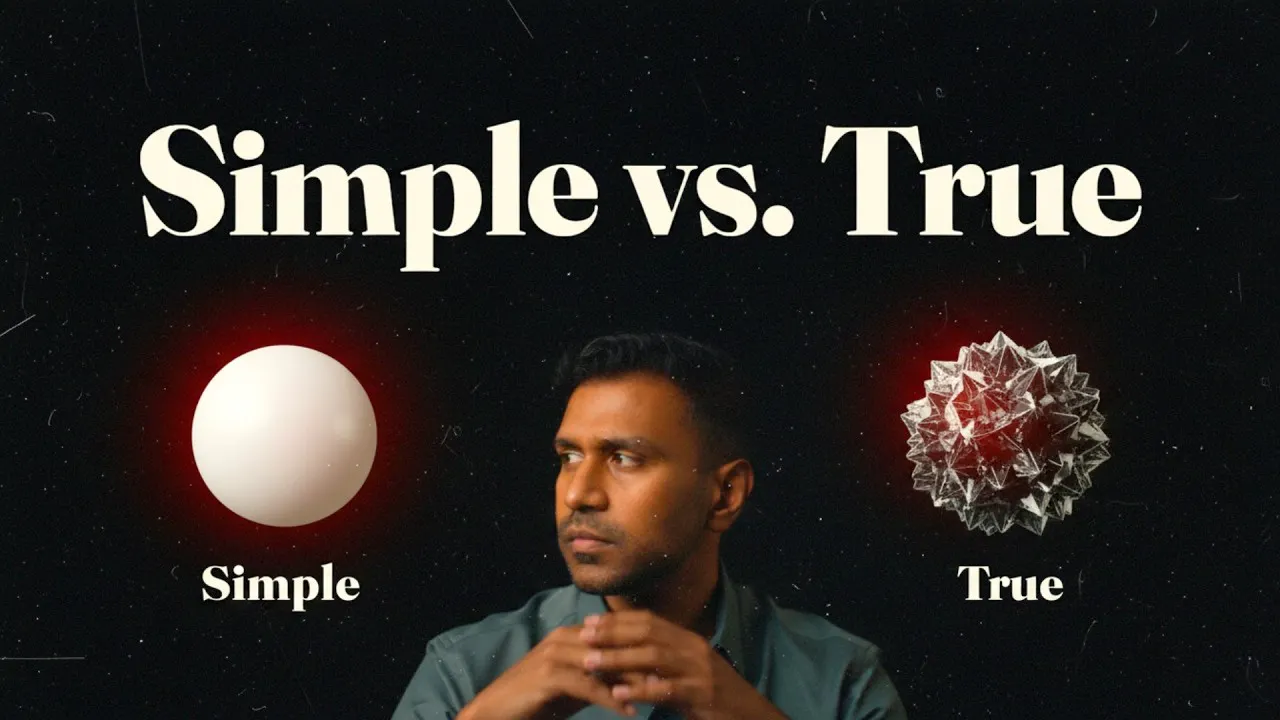
Curt Jaimungal: Explain Like I'm Five? Challenge Accepted.
We examine the common claim that you must be able to explain a concept to a five‑year‑old to truly understand it, arguing that the idea can be misleading and even harmful. The episode explores why some truths resist simplification and shows what genuine understanding looks like for deep learners and teachers.SPONSORS:- I personally subscribe to The Economist. TOE listeners get 35% off the annual s
David Kaiser: MIT Physicist on Black Holes Older Than the Universe
MIT physicist and historian David Kaiser examines primordial black holes, exploring how they might explain dark matter and connect to cosmic inflation. He discusses their potential impact on our understanding of the early universe, linking quantum theory, cosmology, and the history of physics.0:00 What Are Primordial Black Holes?1:41 Could They Be Dark Matter?5:21 Kaiser’s Academic Journey10:56 St
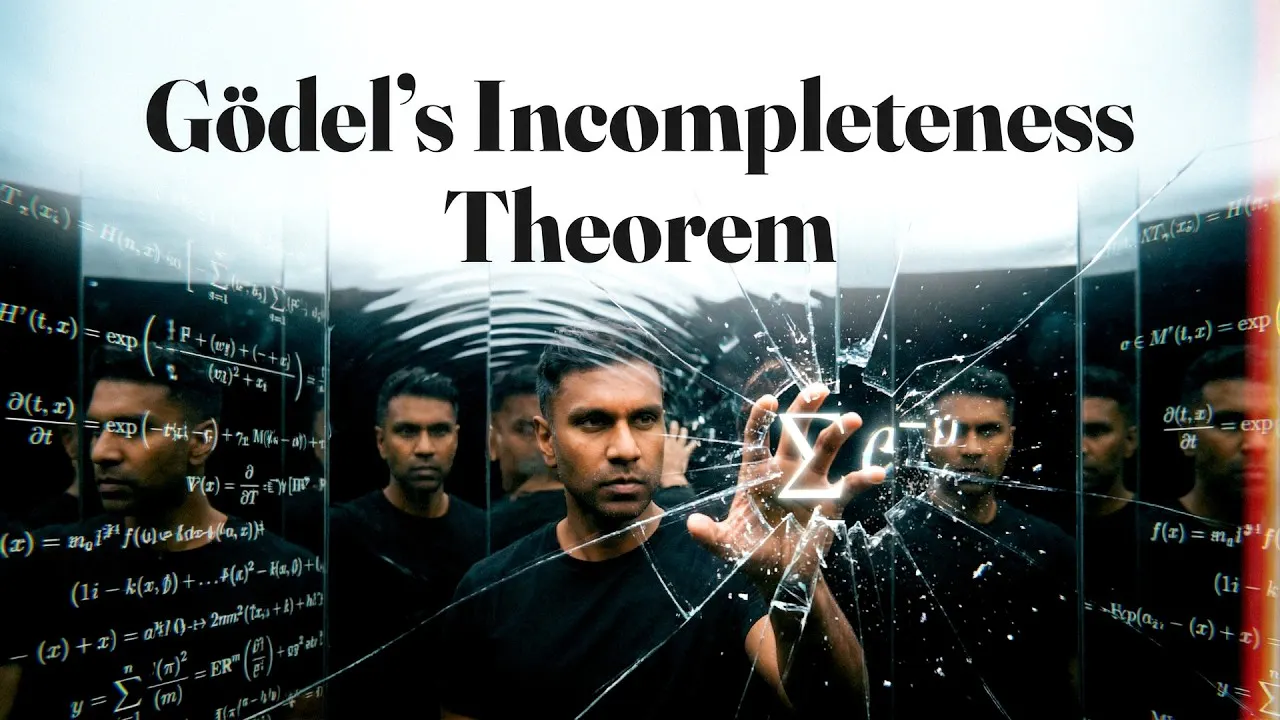
Curt Jaimungal: Demystifying Godel's Theorem
Gödel’s incompleteness theorem is often misrepresented in popular science. In this episode we cut through the hype, correcting misconceptions from figures like Neil deGrasse Tyson, Veritasium, Michio Kaku, and Deepak Chopra, and explain exactly what Gödel proved and what he did not.SPONSORS:- I personally subscribe to The Economist. TOE listeners get 35% off the annual subscription. No other podca
Ted Jacobson: The Proof That Gravity Equals Entropy
Ted Jacobson explains how Einstein's equations emerge from thermodynamic principles, proving gravity is entropic. The discussion explores Rindler horizons, quantum vacuum states, and holographic duality, linking thermodynamics to spacetime geometry.0:00 Introduction1:11 The Journey into Physics4:26 Spirituality and Physics6:29 Connecting Gravity and Thermodynamics9:22 The Concept of Rindler Horizo
Recommended

Marketing Your Business - Marketing Strategies for Business Owners

Mon robot, mon amour

C Un Canadien Pis Une Française

The Successful Bookkeeper Podcast

Black and Blue: Behind the Badge

Senjoh World: Anime Action

Ayush Prakash Podcast

CIBL 101.5 FM : Projection! Salle 6

Emergency Services

Soins de santé

Money and Personal Finance

The Rhema Experience Online
