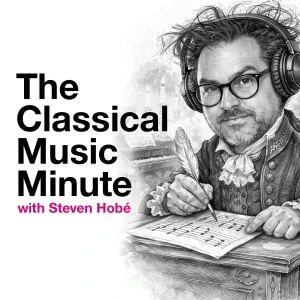
The Classical Music Minute
The Classical Music Minute is a short, engaging podcast that explores the stories, composers, and curious traditions behind classical music. Each episode offers a quick journey through classical music history, covering topics like the Florentine Camerata, the conductor's baton, and differences between opera buffa and opera seria. Hosted by Canadian composer and storyteller Steven Hobé, the show is designed for both lifelong music lovers and newcomers curious about classical music.
Episodes
The Age of Elegance and Order: The Classical Era | The Classical Music Minute
Send us Fan MailClear melodies, balanced forms, and the rise of the symphony helped define the Classical era. It was the age of Haydn and Mozart—and of a young Beethoven beginning to push music in a new direction.Support the showLove classical music? There's more to discover.You can read the companion article and subscribe on Substack at The Classical Music Minute. And for a brand-new narrate
When Music Became Dramatic: The Baroque Era | The Classical Music Minute
Send us Fan MailOpera was born, instrumental music flourished, and major and minor keys became central to Western music. The Baroque era gave us some of classical music’s most enduring forms—and some of its greatest composers.Support the showLove classical music? There's more to discover.You can read the companion article and subscribe on Substack at The Classical Music Minute. And for a bran
Mozart's Search for Independence | In Their Own Words, Part One
Send us Fan MailWhat was Mozart really like when the concert halls fell silent and he sat down to write to his family?In Their Own Words is a special series from The Classical Music Minute that explores the lives of history’s great composers through their personal correspondence. Combining historical context with dramatized readings of their letters, the series takes us beyond the familiar portrai
Music Reborn: The Renaissance Era | The Classical Music Minute
Send us Fan MailPolyphony flourished, madrigals filled courts and homes, and printing helped music travel across Europe. In just two centuries, the Renaissance transformed how Western music was composed, performed, and shared.Support the showLove classical music? There's more to discover.You can read the companion article and subscribe on Substack at The Classical Music Minute. And for a bran
How Did Medieval Music Shape the Western Tradition? | The Classical Music Minute
Send us Fan MailFrom Gregorian chant to polyphony, the Medieval era saw some of Western music’s most important developments—including the growth of musical notation and increasingly complex composition.Support the showLove classical music? There's more to discover.You can read the companion article and subscribe on Substack at The Classical Music Minute. And for a brand-new narrated classical
Why Did Baroque Arias Repeat Themselves? The Da Capo Aria | The Classical Music Minute
Send us Fan MailWhy would an opera aria finish—and then send the singer straight back to the beginning? Discover the da capo aria, a Baroque form that turned repetition into an opportunity for singers to improvise, ornament, and show off their artistry—all in just sixty seconds.Support the showLove classical music? There's more to discover.You can read the companion article and subscribe on S
Before the Blues, There Was John Dowland | The Classical Music Minute
Send us Fan MailSad songs were popular long before modern playlists. Meet John Dowland, the Elizabethan composer and virtuoso lutenist who transformed melancholy into some of the most hauntingly beautiful music of his age—all in just sixty seconds.Support the showLove classical music? There's more to discover.You can read the companion article and subscribe on Substack at The Classical Music
What Were the Apollonian Principles in Stravinsky’s Music? | The Classical Music Minute
Send us Fan MailStravinsky wasn't always the revolutionary behind The Rite of Spring. Discover how the ancient Greek ideal of Apollo—order, clarity, balance, and restraint—helped shape his Neoclassical music and a very different side of his creativity, all in just sixty seconds.Support the showLove classical music? There's more to discover.You can read the companion article and subscribe
What Were Rescue Operas? | The Classical Music Minute
Send us Fan MailPrisoners, secret identities, political oppression—and a daring rescue just in time. Discover how the revolutionary spirit of Europe inspired the rescue opera, a dramatic genre that gave us works such as Beethoven’s Fidelio—all in just sixty seconds.Support the showLove classical music? There's more to discover.You can read the companion article and subscribe on Substack at Th
What Is the Circle of Fifths? | The Classical Music Minute
Send us Fan MailIt looks like a musical clock, but the Circle of Fifths is actually a map of how musical keys relate to one another. Discover how this ingenious diagram helps explain key signatures, harmony, and even how composers move from one key to another—all in just sixty seconds.Support the showLove classical music? There's more to discover.You can read the companion article and subscri
Why Can a Piano Play in Every Key? The Secret of Equal Temperament | The Classical Music Minute
Send us Fan MailWhat if making music sound in tune actually requires making it slightly out of tune? Discover the ingenious compromise of equal temperament and how dividing the octave into twelve equal parts allows musicians to play freely in every key—all in just sixty seconds.Support the showLove classical music? There's more to discover.You can read the companion article and subscribe on S
What Were Goethe's Rules for Actors? | The Classical Music Minute
Send us Fan MailLong before modern acting schools, Johann Wolfgang von Goethe wrote a remarkable guide for performers. Discover why his advice on clarity, discipline, and natural expression still resonates with actors today—all in just sixty seconds.Support the showLove classical music? There's more to discover.You can read the companion article and subscribe on Substack at The Classical Musi
How Did We Start Writing Music? | The Classical Music Minute
Send us Fan MailMusic wasn't always written down. Discover how a medieval monk named Guido of Arezzo helped revolutionize music with a system of notation that still shapes the way musicians read and perform music today—all in just sixty seconds.Support the showLove classical music? There's more to discover.You can read the companion article and subscribe on Substack at The Classical Musi
What Happened to Classical Music in the Early 20th Century? | The Classical Music Minute
Send us Fan MailThe early twentieth century was a time of enormous musical change. Discover how composers responded to a changing world by breaking traditions, experimenting with new sounds, and redefining what classical music could become—all in just sixty seconds.Support the showLove classical music? There's more to discover.You can read the companion article and subscribe on Substack at Th
Drama Meets Music with Monteverdi | The Classical Music Minute
Send us Fan MailOpera didn't appear overnight. Meet Claudio Monteverdi, the composer who transformed music into powerful drama and helped create one of the world's greatest art forms. In just sixty seconds, discover why he's often called the father of opera.Support the showLove classical music? There's more to discover.You can read the companion article and subscribe on Substac
Who Was the First Female Composer? (That We Know Of…) | The Classical Music Minute
Send us Fan MailLet's travel back more than 1,100 years to meet Kassia of Constantinople, the earliest known female composer whose music still survives today. In just sixty seconds, I'll introduce you to this extraordinary Byzantine abbess, poet, and composer whose works are still sung today.Support the showLove classical music? There's more to discover.You can read the companion ar
Who Was the First Great Composer? | The Classical Music Minute
Send us Fan MailJoin me as I introduce you to Pérotin, one of the earliest known composers whose music still survives today. In just sixty seconds, you'll discover how this remarkable medieval composer helped shape the future of Western classical musicSupport the showLove classical music? There's more to discover.You can read the companion article and subscribe on Substack at The Classic
Why Is Wagner So Controversial? | The Classical Music Minute
Send us Fan MailWhy does Richard Wagner remain one of the most debated figures in classical music?In this episode of The Classical Music Minute, we explore the complex legacy of the German composer whose operas revolutionized music drama while also generating lasting controversy.Wagner's artistic influence was profound. His innovations in harmony, orchestration, and storytelling shaped the fu
Why Do Symphony Orchestras Have So Many Violins? | The Classical Music Minute
Send us Fan MailWhy are there so many violins in a symphony orchestra?In this episode of The Classical Music Minute, we explore the role of the violin section and why it often contains more players than any other group in the orchestra.Because a single violin produces a relatively delicate sound, many players are needed to create the rich, powerful sonority associated with orchestral strings. Viol
How Do Opera Singers Sing So Loud Without Microphones? | The Classical Music Minute
Send us Fan MailHow can opera singers be heard over an entire orchestra without any electronic amplification?In this episode of The Classical Music Minute, we explore the fascinating science behind operatic singing. Contrary to popular belief, opera singers do not simply sing louder than everyone else. Instead, they train for years to develop breath control, resonance, and efficient vocal producti
Why Is Beethoven’s Ninth Symphony So Important? | The Classical Music Minute
Send us Fan MailWhy is Beethoven’s Ninth Symphony considered one of the most important works in classical music?In this episode of The Classical Music Minute, we explore the revolutionary ideas behind Beethoven’s final completed symphony. Premiered in 1824, the work broke new ground by introducing a choir and vocal soloists into the final movement—something virtually unheard of in a symphony at th
What Is the Difference Between Opera and Operetta? | The Classical Music Minute
Send us Fan MailWhat is the difference between opera and operetta?In this episode of The Classical Music Minute, we explore two closely related forms of musical theatre. Opera is usually larger in scale and often more serious in tone, with music driving the drama from beginning to end. Many operas deal with intense themes such as love, tragedy, power, fate, and betrayal.Operetta, whose name means
Why Did Beethoven Go Deaf? | The Classical Music Minute
Send us Fan MailWhy did Beethoven lose his hearing?In this episode of The Classical Music Minute, we explore one of the most famous mysteries in music history. Ludwig van Beethoven began experiencing hearing problems in his late twenties, including ringing in the ears and difficulty hearing high sounds and distant voices.By 1802, he knew the condition was serious and progressive. During a stay in
Why Is Pachelbel’s Canon Played at So Many Weddings? | The Classical Music Minute
Send us Fan MailWhy has Pachelbel’s Canon in D become one of the most popular wedding pieces of all time?In this episode of The Classical Music Minute, we explore how a Baroque composition written centuries ago became closely associated with modern wedding ceremonies.Known for its flowing melodies and repeating harmonic progression, Canon in D creates a calm and elegant atmosphere that naturally s
Why Is Vivaldi’s Four Seasons So Popular? | The Classical Music Minute
Send us Fan MailWhy has The Four Seasons remained one of the world’s most recognizable pieces of classical music?In this episode of The Classical Music Minute, we explore the enduring popularity of Antonio Vivaldi’s famous set of violin concertos. Written in the early eighteenth century, The Four Seasons uses music to depict scenes from nature, including birdsong, storms, flowing water, hunting sc
Why Is Bach Called the Father of Classical Music? | The Classical Music Minute
Send us Fan MailWhy Is Bach Called the Father of Classical Music?Why is Johann Sebastian Bach often referred to as the “Father of Classical Music”?In this episode of The Classical Music Minute, we explore the lasting influence of one of history’s greatest composers. Although Bach lived during the Baroque period, his work laid the foundation for much of the music that followed.Renowned for his mast
What Does “Opus” Mean in Classical Music? | The Classical Music Minute
Send us Fan MailWhat Does “Opus” Mean in Classical Music?What does “opus” mean when you see it in a classical music title?In this episode of The Classical Music Minute, we explore the meaning behind this common musical term. Derived from the Latin word for “work,” opus numbers are used to catalogue and organize a composer’s compositions.Typically assigned in order of publication rather than compos
Why Did Mozart Write So Many Operas? | The Classical Music Minute
Send us Fan MailWhy did Mozart compose so many operas during his short lifetime?In this episode of The Classical Music Minute, we explore why opera played such an important role in Mozart’s career. In the late eighteenth century, opera was one of Europe’s most popular forms of entertainment, and cities across the continent regularly commissioned new works for their theatres.Mozart was uniquely sui
Why Is Beethoven’s Symphony No. 5 So Famous? | The Classical Music Minute
Send us Fan MailWhy is Beethoven’s Symphony No. 5 one of the most recognizable pieces of music ever written?In this episode of The Classical Music Minute, we explore the famous four-note opening that begins the symphony—often described as da-da-da-DAAA. This simple rhythmic motif becomes the driving force behind the entire first movement, demonstrating Beethoven’s extraordinary ability to develop
Why Do Orchestras Tune to the Oboe? | The Classical Music Minute
Send us Fan MailWhy Do Orchestras Tune to the Oboe?Why do orchestras tune to the oboe before a concert begins?In this episode of The Classical Music Minute, we explore the tradition behind the single tuning note that signals the start of nearly every orchestral performance.Before the music begins, the principal oboist plays an A—typically A = 440 hertz—and the rest of the orchestra tunes to match
Why Is Pachelbel’s Canon in D Played at Weddings? | The Classical Music Minute
Send us Fan MailWhy is Pachelbel’s Canon in D played at weddings?In this episode of The Classical Music Minute, we explore how a small Baroque chamber work by Johann Pachelbel unexpectedly became one of the most popular wedding processional pieces in the world.Written around 1680, Canon in D was originally composed for three violins and basso continuo, with no connection to weddings at all. Its fa
Mascagni’s Cavalleria rusticana Intermezzo: A Moment of Pure Emotion
Send us Fan MailDescriptionMascagni’s Cavalleria rusticana Intermezzo: A Moment of Pure Emotion in 60 Seconds. Take a minute to get the scoop!Fun FactMascagni was only 26 when Cavalleria rusticana premiered—and it immediately made him famous. The opera was written for a composition competition, which he won. Despite composing many works afterward, the Intermezzo became his most beloved music, ofte
Holst’s Mars: The Sound of War Approaching in 60 Seconds
Send us Fan MailDescriptionHolst’s Mars: The Sound of War Approaching in 60 Seconds. Take a minute to get the scoop!Fun FactHolst actually wrote Mars before World War I fully erupted, yet many listeners later assumed it was inspired by the conflict. In reality, the piece reflects the astrological character of Mars rather than a specific war—but its ominous power made it feel uncannily prophetic.Ab
The Barber of Seville in 60 Seconds
Send us Fan MailDescriptionThe Barber of Seville in 60 Seconds. Take a minute to get the scoop!Fun FactThe opera’s opening night in Rome was a disaster — with onstage accidents and audience hostility — but it quickly became one of the most performed operas in history.About Steven, HostSteven is a Canadian composer & actor living in Toronto. Through his music, he creates a range of works, with
La clemenza di Tito in 60 Seconds
Send us Fan MailDescriptionLa clemenza di Tito in 60 Seconds. Take a minute to get the scoop!Fun FactMozart composed La clemenza di Tito in about 18 days for the coronation of Emperor Leopold II in Prague — while simultaneously finishing The Magic Flute.About Steven, HostSteven is a Canadian composer & actor living in Toronto. Through his music, he creates a range of works, with an emphasis on
Beethoven: The Bridge Between Two Worlds
Send us Fan MailDescriptionBeethoven: The Bridge Between Two Worlds in 60 Seconds. Take a minute to get the scoop!Fun FactBy the time Beethoven premiered his Ninth Symphony, he was completely deaf. Unable to hear the applause, he had to be turned around onstage to see the audience cheering. It was a powerful moment—one that perfectly captured his role as a composer who transcended personal limitat
Debussy and the Sound of Impressionism
Send us Fan MailDescriptionDebussy and the Sound of Impressionism in 60 Seconds. Take a minute to get the scoop!Fun FactDebussy disliked the term “Impressionism,” insisting it was borrowed from painting and misunderstood his music. He preferred to think of his works as “images” in sound. Ironically, the label stuck—and today it’s nearly impossible to imagine Impressionism without Debussy at its ce
The Fugue: Discipline, Drama, and Design
Send us Fan MailDescriptionThe Fugue: Discipline, Drama, and Design in 60 Seconds. Take a minute to get the scoop!Fun FactBach’s The Art of Fugue was left unfinished at his death, ending abruptly mid-piece. Legend claims he was working on a final fugue spelling his own name in musical notes—B-A-C-H. Whether intentional or not, the idea feels fitting: a composer signing off using pure musical desig
Theme and Variations: Order vs. Imagination
Send us Fan MailDescriptionTheme and Variations: Order vs. Imagination in 60 Seconds. Take a minute to get the scoop!Fun FactSome variation sets were written as showpieces to prove compositional skill. Brahms once joked that anyone could write a good theme, but only a real composer could write convincing variations. Beethoven agreed—he used the form repeatedly when he wanted to demonstrate both di
The Art Song: When Poetry Met Music
Send us Fan MailDescriptionThe Art Song: When Poetry Met Music in 60 Seconds. Take a minute to get the scoop!Fun FactSchubert wrote over 600 art songs, many for informal gatherings with friends called Schubertiades. Performers often sang straight from handwritten manuscripts while the composer turned pages. Some of the most treasured songs in Western music began as living-room experiments rather t
From Court to Concert Hall: The Shift from Patronage to Public Audiences
Send us Fan MailDescriptionFrom Court to Concert Hall: The Shift from Patronage to Public Audiences in 60 Seconds. Take a minute to get the scoop!Fun FactBeethoven famously tore the dedication page from his Eroica Symphony when Napoleon crowned himself emperor. The gesture symbolized a larger shift: composers were no longer servants flattering rulers, but artists answering to ideals—and to paying
Why the Symphony Became a Cultural Symbol
Send us Fan MailDescriptionWhy the Symphony Became a Cultural Symbol in 60 Seconds. Take a minute to get the scoop!Fun FactBeethoven’s Ninth Symphony was the first to include a chorus in a symphony—an audacious move at the time. Critics were baffled. Today, its “Ode to Joy” theme is used as the anthem of the European Union, proving the symphony’s power to move from concert hall to cultural symbol.
Music After World War I: Art in a Shattered World
Send us Fan MailDescriptionMusic After World War I: Art in a Shattered World in 60 Seconds. Take a minute to get the scoop!Fun Fact In 1918, Erik Satie described postwar music as needing “fewer perfumes and more reality.” Many composers shared this sentiment, favoring sharp edges and transparency over lush emotion. Audiences weren’t always thrilled—but history proved these reactions marked the bir
Bartók: When Folk Music Met Modernism
Send us Fan MailDescriptionBartók: When Folk Music Met Modernism in 60 Seconds. Take a minute to get the scoop!Fun FactBartók wasn’t just inspired by folk music—he treated it like scientific research. Armed with a phonograph, he recorded villagers singing in remote areas, often in harsh conditions. He transcribed songs note by note, preserving traditions that might otherwise have vanished. In the
The Oratorio: Opera Without the Costumes
Send us Fan MailDescriptionThe Oratorio: Opera Without the Costumes in 60 Seconds. Take a minute to get the scoop!Fun FactWhen Messiah premiered in Dublin, audiences were asked to leave their swords at home and ladies were encouraged not to wear hoop skirts—so more people could fit in the hall. Even then, Handel was drawing a crowd. The famous tradition of standing during the “Hallelujah” Chorus c
Erik Satie: The Unlikely Godfather of Les Six
Send us Fan MailDescriptionErik Satie: The Unlikely Godfather of Les Six in 60 Seconds. Take a minute to get the scoop!Fun FactSatie gave his pieces absurd titles like Three Pieces in the Shape of a Pear—a jab at critics who accused him of lacking musical “form.” Les Six adored this irreverence. Poulenc once said Satie proved that “music could smile without losing its intelligence,” a lesson he to
Les Six: Paris’s Modern Musical Short-Lived Spark
Send us Fan MailDescriptionLes Six: Paris’s Modern Musical Short-Lived Spark in 60 Seconds. Take a minute to get the scoop!Fun FactLes Six officially collaborated on only one major project, L’Album des Six (1920), before drifting apart. Ironically, the brevity of their partnership helped mythologize them: critics kept the label alive long after the composers stopped meeting, turning a short-lived
Francis Poulenc: The Man and His Music
Send us Fan MailDescriptionFrancis Poulenc: The Man and His Music in 60 Seconds. Take a minute to get the scoop!Fun FactPoulenc adored Parisian cabarets and often slipped their cheeky harmonic twists into his classical works. After a friend accused him of being “too frivolous,” he replied, “You must take me as I am—Ravel for breakfast and a good music-hall number for dessert.” About Steven, HostSt
Echoes Along the Nile: Music in Ancient Egypt
Send us Fan MailDescriptionEchoes Along the Nile: Music in Ancient Egypt in 60 Seconds. Take a minute to get the scoop!Fun FactThe sistrum—a sacred rattle associated with the goddess Hathor—was believed to ward off evil spirits. Priests shook it during ceremonies to “awaken” the gods. Archaeologists have found beautifully ornamented versions made of bronze and faience, proving even ancient noisema
The Musician’s Life in the Romantic Era
Send us Fan MailDescriptionThe Musician’s Life in the Romantic Era in 60 Seconds. Take a minute to get the scoop!Fun FactFranz Liszt was the 19th-century equivalent of a rock star. Fans reportedly fought over his discarded gloves and hair strands, a frenzy dubbed Lisztomania. While his performances caused swooning in concert halls, his income often relied more on teaching and touring than on the s
Mozart’s Piano: The Enlightenment’s Favourite Sound Machine
Send us Fan MailDescriptionMozart’s Piano: The Enlightenment’s Favourite Sound Machine in 60 Seconds. Take a minute to get the scoop!Fun FactMozart loved his personal fortepiano so much he took it on tour. It still survives today in Salzburg. Unlike modern pianos, its keys are wood-topped, not ivory, and its sound is surprisingly intimate—more like a lively conversation than a thunderous recital.
Harmony Behind Stone Walls: Life in the Medieval Cloister
Send us Fan MailDescriptionHarmony Behind Stone Walls: Life in the Medieval Cloister in 60 Seconds. Take a minute to get the scoop!Fun FactThe earliest Western musical notation emerged in monasteries, where scribes invented “neumes”—tiny marks above text to guide singers. This humble invention paved the way for modern sheet music. So, the next time you read a score, thank a monk with very steady h
Benjamin Britten’s The Young Person’s Guide to the Orchestra: A Musical Who’s Who
Send us Fan MailDescriptionBenjamin Britten’s The Young Person’s Guide to the Orchestra: A Musical Who’s Who in 60 Seconds. Take a minute to get the scoop!Fun FactWhen The Young Person’s Guide to the Orchestra premiered, Britten wasn’t sure audiences would take it seriously. He needn’t have worried—it’s now one of the most-performed orchestral works ever written for education. Ironically, it’s als
The Pulse Redefined: Rhythmic Complexity in 20th-Century Music
Send us Fan MailDescriptionThe Pulse Redefined: Rhythmic Complexity in 20th-Century Music in 60 Seconds. Take a minute to get the scoop!Fun FactWhen The Rite of Spring premiered in Paris, 1913, its jarring rhythms helped cause a near riot. Audience members shouted, booed, and even fought. A century later, the same rhythms are considered masterpieces of modernity—proof that innovation often sounds
Breaking the Spell: Reaction Against Romanticism in Early 20th-Century Music
Send us Fan MailDescriptionBreaking the Spell: Reaction Against Romanticism in Early 20th-Century Music” in 60 Seconds. Take a minute to get the scoop!Fun FactWhen Stravinsky’s Pulcinella premiered in 1920, audiences were puzzled—was it parody, homage, or rebellion? Stravinsky called it “a look backward with a smile,” summing up the entire neoclassical spirit: modern sensibility dressed in old-fas
Mozart in Miniature: Master of Chamber Music
Send us Fan MailDescriptionMozart in Miniature: Master of Chamber Music in 60 Seconds. Take a minute to get the scoop!Fun FactMozart’s publisher worried that his Piano Quartet in G minor (1785) was too difficult for amateurs—the intended market for chamber music. Sales flopped at first, but the piece later became a cornerstone of the repertoire. It’s a reminder that Mozart sometimes wrote not for
Form, Function, and Flourish: The Classical Sonata
Send us Fan MailDescriptionForm, Function, and Flourish: The Classical Sonata in 60 Seconds. Take a minute to get the scoop!Fun FactBeethoven’s “Moonlight” Sonata wasn’t named by him at all—the nickname came years later, when a critic compared its first movement to moonlight on Lake Lucerne. Beethoven might have rolled his eyes, but the title stuck, and today it’s one of the most famous (and misin
Back to the Future: Neoclassicism in Music
Send us Fan MailDescriptionBack to the Future: Neoclassicism in Music in 60 Seconds. Take a minute to get the scoop!Fun FactStravinsky admitted that Pulcinella wasn’t just homage—it was liberation. “It was a backward look, of course,” he said, “but it was a look in the mirror too.” By reworking 18th-century melodies with his own twists, he essentially invented neoclassicism—proving that recycling
Faraway Fantasies: Exoticism in Opera
Send us Fan MailDescriptionFaraway Fantasies: Exoticism in Opera in 60 Seconds. Take a minute to get the scoop!Fun FactWhen Carmen premiered, critics complained it was too scandalous and “vulgar” for the Paris stage. Yet the opera’s Spanish flair and exotic energy soon captivated Europe. Ironically, Bizet never visited Spain—the rhythms and melodies came from French collections of “Spanish” tunes.
Showtime with Strings Attached: The Romantic Concerto
Send us Fan MailDescriptionShowtime with Strings Attached: The Romantic Concerto in 60 Seconds. Take a minute to get the scoop!Fun FactFranz Liszt’s piano concertos were so demanding that critics sometimes accused him of showing off. He didn’t mind—he once said performing should “transport the listener.” Paganini caused similar uproar: audiences whispered he’d sold his soul to the devil to master
Bigger, Louder, Wilder: The Romantic Orchestra Arrives
Send us Fan MailDescriptionBigger, Louder, Wilder: The Romantic Orchestra Arrives in 60 Seconds. Take a minute to get the scoop!Fun FactWagner was so ambitious he built his own opera house in Bayreuth just to fit the expanded orchestra he envisioned. His pit design hid the musicians from the audience—so all you saw was drama on stage while an enormous, unseen orchestra unleashed waves of sound ben
Berlioz & the Program Symphony: When Music Told the Whole Story
Send us Fan MailDescriptionBerlioz & the Program Symphony: When Music Told the Whole Story in 60 Seconds. Take a minute to get the scoop!Fun FactBerlioz claimed Symphonie fantastique was inspired by his infatuation with Irish actress Harriet Smithson, whom he later married—briefly. She didn’t attend the premiere, but when she finally heard it, she was impressed… and a little alarmed. Courtship
Small Rooms, Big Genius: Mozart’s Chamber Music
Send us Fan MailDescriptionSmall Rooms, Big Genius: Mozart’s Chamber Music in 60 Seconds. Take a minute to get the scoop!Fun FactMozart’s Clarinet Quintet was written for his friend Anton Stadler, whose extended-range clarinet could play lower notes than normal. Mozart adored the instrument’s warm tone—so much so that he later wrote his famous Clarinet Concerto for Stadler. Friendship goals: writi
Lutes, Lyrics, and Life on the Road: Meet the Medieval Minstrels
Send us Fan MailDescriptionLutes, Lyrics, and Life on the Road: Meet the Medieval Minstrels in 60 Seconds. Take a minute to get the scoop!Fun FactMinstrels had to pass on their songs by memory, since music printing wouldn’t arrive until the 15th century. That meant performances changed over time—sometimes intentionally, sometimes forgetfully. A tale sung in France might sound very different once i
If the Music Fits, Sing It: The Art of Word Painting
Send us Fan MailDescriptionIf the Music Fits, Sing It: The Art of Word Painting in 60 Seconds. Take a minute to get the scoop!Fun FactIn Weelkes’ madrigal "As Vesta Was from Latmos Hill Descending", the word “descending” is literally sung with downward scales—meanwhile, “ascending” climbs right back up. Even “running down” gets a rapid, breathless passage. It’s one of the earliest—and ch
Notes on Repeat: How the Printing Press Changed Music Forever
Send us Fan MailDescriptionNotes on Repeat: How the Printing Press Changed Music Forever in 60 Seconds. Take a minute to get the scoop!Fun FactPetrucci’s music prints were so beautifully done that people treated them like prized books. His triple-impression method printed staves, then notes, then text—a slow process, but incredibly precise. Later printers opted for faster techniques, but Petrucci’
When One Voice Became Many: The Rise of Polyphony
Send us Fan MailDescriptionWhen One Voice Became Many: The Rise of Polyphony in 60 Seconds. Take a minute to get the scoop!Fun FactIn early polyphonic music, singers didn’t always have rhythm notated. They had to feel their way through the parts. Imagine performing complex interwoven melodies… by ear! It wasn’t until the 13th century that rhythmic notation caught up. Until then, performances were
Opera à la Carte: Rossini, Risotto, and the Birth of a Beloved Aria
Send us Fan MailDescriptionOpera à la Carte: Rossini, Risotto, and the Birth of a Beloved Aria in 60 Seconds. Take a minute to get the scoop!Fun FactRossini retired from composing operas at just 37, choosing to focus on fine food and entertaining. He invented or inspired several gourmet dishes—like Tournedos Rossini, topped with foie gras and truffles. For Rossini, music and food weren’t separate
Knock Knock... It’s Fate: The Four Notes That Shook the World
Send us Fan MailDescriptionKnock Knock... It’s Fate: The Four Notes That Shook the World in 60 Seconds. Take a minute to get the scoop!Fun FactDuring WWII, Allied radio broadcasts began with the da-da-da-DUM motif because its rhythm matched the Morse code for “V” (•••–), symbolizing “Victory.” Beethoven’s Fifth thus became a sonic emblem of resistance—proof that four notes written in 1808 could he
When a Cello Speaks: The Heartbreaking Opening of Elgar’s Concerto
Send us Fan MailDescriptionWhen a Cello Speaks: The Heartbreaking Opening of Elgar’s Concerto in 60 Seconds. Take a minute to get the scoop!Fun FactElgar’s Cello Concerto premiered in 1919—and flopped. Overshadowed by rehearsal mishaps, it wasn’t until Jacqueline du Pré’s 1965 recording that the piece gained fame. Today, its opening bars are considered some of the most emotionally gripping in clas
That Note from Heaven: The Top C in Allegri’s Miserere
Send us Fan MailDescriptionThat Note from Heaven: The Top C in Allegri’s Miserere in 60 Seconds. Take a minute to get the scoop!Fun FactThe Vatican once banned copying Miserere, enforcing secrecy to protect its mystique. Young Mozart heard it once in 1770 and wrote it out entirely from memory. This musical jailbreak helped make the soaring top C famous—and added to Mozart’s legend as a prodigious
Lip Gymnastics: The Wild World of Horn Embouchure
Send us Fan MailDescriptionLip Gymnastics: The Wild World of Horn Embouchure in 60 Seconds. Take a minute to get the scoop!Fun FactHorn players often practice just buzzing their lips into a mouthpiece—no horn needed—while driving, walking, or even watching TV!__________________________________________________________________About Steven, HostSteven is a Canadian composer & actor living in Toro
Puff, Play, Breathe: The Oboe’s Magic Trick
Send us Fan MailDescriptionPuff, Play, Breathe: The Oboe’s Magic Trick in 60 Seconds. Take a minute to get the scoop!Fun FactSome oboists have used circular breathing to play continuous notes for over 45 minutes—long enough to make a sandwich between breaths!__________________________________________________________________About Steven, HostSteven is a Canadian composer & actor living in Toron
🎼 Mahler’s Motto: Go Big or Go Back to Vienna
Send us Fan MailDescriptionMahler’s Motto: Go Big or Go Back to Vienna in 60 Seconds. Take a minute to get the scoop!Fun FactMahler’s Symphony No. 8 premiered in 1910 with over 1,000 performers on stage. Though “Symphony of a Thousand” wasn’t his title, the name stuck. It was one of the largest-scale choral works ever attempted—and still gives orchestra managers mild panic attacks every time it’s
🎶 The Nutcracker? No Thanks, Said Tchaikovsky (At First)
Send us Fan MailDescriptionThe Nutcracker? No Thanks, Said Tchaikovsky (At First) in 60 Seconds. Take a minute to get the scoop!Fun FactTchaikovsky didn't trust Russian composers not to steal his idea of using the celesta for The Nutcracker, so he had it secretly shipped from Paris. He needn’t have worried—now it’s hard to imagine Christmas without it. He didn’t love the ballet, but the celes
Lisztmania: The First True Fan Frenzy
Send us Fan MailDescriptionLisztmania: The First True Fan Frenzy in 60 Seconds. Take a minute to get the scoop!Fun FactLisztmania wasn’t just poetic—it was real, and intense. Fans fought over Liszt’s handkerchiefs, collected his hair, and wore cameos bearing his face. Some even claimed his music had healing powers. Critics struggled to understand the frenzy, but audiences simply couldn't get
When Titans Duel: Handel vs. Scarlatti in the Baroque Showdown
Send us Fan MailDescriptionWhen Titans Duel: Handel vs. Scarlatti in the Baroque Showdown in 60 Seconds. Take a minute to get the scoop!Fun FactIn early 1700s Rome, Handel and Scarlatti participated in a legendary keyboard duel judged by local nobility. Though equals on the harpsichord, Handel’s mastery of the organ gave him the edge. Scarlatti reportedly acknowledged Handel’s superiority—an extra
How Medieval Monks Invented the Way We Write Music Today
Send us Fan MailDescriptionHow Medieval Monks Invented the Way We Write Music Today in 60 Seconds. Take a minute to get the scoop!Fun FactBefore musical notation, music was passed down by memory! Around the 9th century, monks created neumes—squiggly symbols above lyrics—to guide melodies. Guido of Arezzo later added the staff and pitch names. His system was so effective, it’s still the basis for h
How Beethoven Composed Masterpieces Without Hearing a Sound
Send us Fan MailDescriptionHow Beethoven Composed Masterpieces Without Hearing a Sound in 60 Seconds. Take a minute to get the scoop!Fun FactBeethoven composed some of his greatest works after going completely deaf! He couldn’t hear a single note but used his deep understanding of music and felt vibrations through the piano. His Ninth Symphony—featuring “Ode to Joy”—was written in total silence, y
Gounod’s Divine Remix: A Heavenly Twist on Bach
Send us Fan MailDescriptionGounod’s Divine Remix: A Heavenly Twist on Bach in 60 Seconds. Take a minute to get the scoop!Fun FactGounod’s Ave Maria wasn't originally intended as a standalone work. It began as an improvisation over Bach’s 1722 prelude, and the Latin prayer was added later. Today, it's often mistakenly credited to Bach alone, despite Gounod’s soaring melody being the emoti