Cities 1.5
Cities 1.5 is a podcast about progressive urban policy and climate action, hosted by David Miller. It features conversations with mayors, policymakers, economists, and youth leaders on limiting global heating to 1.5 degrees. The show is an extension of the Journal of City Climate Policy and Economy. It aims to discuss pressing economic and policy issues facing cities in their climate leadership.
Episodes

Oh, Canada: Living with fire in a warming world
As catastrophic wildfires intensify across Canada - destroying homes, blanketing the country in smoke, forcing evacuations, and driving major economic losses - we ask in this episode what it will take to live with fire in a warming world. David sits down with returning guest to the podcast, fire ecologist and professor Jen Baron, to hear how decades of suppression and the disruption of Indigenous

Oh, Canada: How did we get here?
Canada is having a moment: our reputation and soft power are growing. In the face of unexpected tariffs, a deepening housing crisis, and skyrocketing cost of living, Canadians are asking who we really are, what we want to stand for…and what lies ahead. There is great opportunity to be had, but also great risk in the road ahead. Canada needs energy independence and geopolitical protection - but Mar

TRAILER: Oh, Canada: Solutions for the Climate Crisis
Climate change can feel frightening and uncertain - so much so, in fact, that sometimes hope can feel like an act of denial. But hope isn’t denial: it’s a recognition that we still have choices.In our new Cities 1.5 limited miniseries, Oh, Canada: Solutions for the Climate Crisis, we’re speaking to Canadians from coast, to coast, to coast, who are turning those choices into action. Featuring voice

Be Hope: Cities 1.5 presents a special preview of Oh, Canada - Solutions for the Climate Crisis
What if there are reasons to hope for a more resilient climate future in your own backyard - right here in Canada? Well, that’s exactly the question we’re asking in our new miniseries, Oh, Canada: Solutions for the Climate Crisis. At Cities 1.5, we’re proud to join forces with voices around the world for the 2026 #BeHope Podcast Takeover. We’re coming together to prove that even in challenging tim

HOT TAKE: "A Captain never leaves his ship."
When the full-scale Russian invasion of Ukraine began in February 2022, local leaders found themselves thrust onto the frontlines of both military defense and environmental catastrophe. Coupled with untold amounts of human suffering, the war has inflicted deep environmental scars - from the destruction of the Kakhovka Dam to the corrosion of municipal water pipes - which many Ukrainian officials

HOT TAKE: Urban Legends - Sorting City Climate Facts from Fiction
As the climate crisis accelerates, our information ecosystem has become a critical battleground. Coordinated climate disinformation - driven by fossil fuel interests - is increasingly targeting cities and urban leaders to stall transformative policy and manufacture public doubt.In this special Hot Takes episode recorded on the ground at London Climate Action Week, host David Miller examines how ci

HOT TAKE: Can Cities Clean Up the Cloud?
As the AI boom drives an unprecedented rush for computing power, cities face a critical question: how do we support digital expansion, without derailing net-zero climate goals? Left unregulated, data centers can consume staggering amounts of energy and water, threaten to destabilise power grids, strain local resources, and alienate communities. But it doesn’t have to be like this: city leaders are

The Shipping Forecast: Climate Edition
The winds of change are blowing through the world’s maritime hubs…despite some national governments’ efforts to the contrary. While the shipping industry carries 90% of global trade, it also leaves a heavy carbon trail in its wake. In this episode of Cities 1.5, we explore the high-stakes transformation of our global ports: once seen as industrial hotspots of pollution, these urban harbours are em

Creating ecosystems of climate truth: How can cities defend information integrity?
From fossil fuel lobbying to coordinated political disinformation campaigns, vested interests have built a profitable disinformation infrastructure designed to spread confusion, polarize debate, and exhaust the public. The good news is that the world is waking up. For the first time in the history of the COP, a Declaration on Information Integrity was agreed upon, with governments committing to ad

The Cloud vs the Climate? Lessons from Ireland on the data centre debate
As our lives become increasingly digital, the infrastructure powering them is sparking a global debate: we need data centres, but at what cost to the climate and our access to energy? These massive facilities are the backbone of everything from streaming to AI, yet they consume staggering amounts of electricity and water, often straining local grids and and in some cases, threatening to derail dec

HOT TAKE: One day, millions of journeys: Celebrating World Public Transport Day!
Ready for a ride? In this episode, we’re celebrating the inaugural World Public Transport Day, created by the International Association of Public Transport (UITP), along with its global partners, and we explore why public transport is the beating heart of our cities. From the "rolling focus groups" on Melbourne’s iconic trams to the colorful jeepneys of the Philippines, we share persona

The Hidden Infrastructure of Urban Resilience
Cities aren’t just structures. They’re people. In the rapidly urbanising cities of the global majority, many of those people are migrant workers. They often work informally, with limited protection when shocks hit. At the same time, they are vital to propping up and rebuilding cities after climate disasters. In this week’s Cities 1.5 podcast episode, host David Miller speaks to Ritwika Basu, an e

A Tale of Two Cities: A New Chapter
In this episode of Cities 1.5, we bring you another "Tale of Two Cities" - but this time, David sits down with two pioneering mayors from opposite ends of the globe. Despite their vastly different histories, both Athens are Melbourne are inspiring and leading the way through the climate crisis, and mitigating its impacts.We explore Athens is embracing progressive economics and tackling e

Lead like a girl - In conversation with Catherine McKenna
What links the Paris Agreement, Barbie and Arnold Schwarzenegger? The answer is this week’s guest on Cities 1.5!As a key architect of the Paris Agreement, Catherine McKenna - Canada’s former Minister for Climate Change and the Environment - reflects on why cities are now the true engines of delivery. There’s also a powerful exploration of Catherine’s new memoir, Run Like a Girl, and a firsthand ac

Whose Streets? Our Streets: Curbing Fossil Fuel Industry Disinformation
In a world where climate emergencies are being declared daily, why do so many of our city streets and public transport networks have misleading ads for the very industries driving the crisis?Our conversation with two C40 experts reveals how the fossil fuel industry mirrors old tobacco industry tactics using sophisticated techniques to "greenwash" their image and frame essential health pr

HOT TAKE: The Kids are alright - Youth take the Mic in Rio
Hot Take: the climate crisis isn’t some abstract data point or a dry policy debate, it’s a deeply human story of survival. Right now, a whole generation is growing up inside the emergency, doing the heavy lifting to fix a mess they didn't create. We’re bringing you the raw, human heartbeat of the movement and amplifying the voices that stole the show at the World Mayor’s Summit in Rio. The C4

Tales from the Belly of the Beast: An ExxonMobil Whistleblower’s Story
What would you risk to tell the truth, if the institution you served was one of the most powerful corporations on Earth?Early scientific warnings about global heating have long stood in tension with corporate narratives shaping public understanding. This episode examines the enduring disinformation created and disseminated by the fossil fuel industry: how it evolves, why it persists, and what it m

Mayoral Deep Dive: US cities as climate first responders
Across the United States, cities are acting as climate first responders - carrying climate action forward even as national politics grow more hostile. From clean energy and buildings to transport, land use and resilience to extreme weather events, mayors are proving that climate leadership does not depend on federal permission. It grows from proximity: to people, to impacts, and to the places lead

Economics and the City
In times of profound geopolitical turbulence - wars, trade shocks, energy insecurity, and climate breakdown - something unexpected is happening: while autocratic leaders double down on fossil fuels and climate denial, cities are stepping into the breach to create a different story. One of hope, resilience, and innovation.Like wildflowers pushing through concrete, cities around the world are experi
TRAILER: Cities Won't Wait
As geopolitical power shifts, cities are rising to lead this urban century while nations cling to outdated systems. Season 6 of Cities 1.5 explores how mayors and urban leaders from around the world are turning uncertainty into opportunity, building regenerative futures with hope-filled narratives that counter disinformation and inspire action.Join us from January 13, 2026, as we explore the urban
TEASER: Season 6 of Cities 1.5 is coming soon!
In the face of the accelerating climate crisis, rising authoritarianism, and geopolitical shifts, national governments are faltering…but cities are stepping into the void and taking the lead. Season 6 of Cities 1.5 will delve into how municipal-level actions and powerful coalitions are creating a carbon-free future, promoting resilience, and enabling a new economic system based on wellbeing over

HOT TAKE: It’s Grand Ol’ Bargain, Alright (for Canada’s fossil-fuel companies)
Welcome to Cities 1.5 Hot Takes: Dispatches from the Frontlines of the Climate Crisis. Hot Takes brings you fast, focused coverage on breaking news and underserved stories at the intersection of climate, economics and public health - all through an urban lens. This first-ever edition of Hot Takes is about a major move in Canada’s energy future…and what it means for climate, cities, and the promise
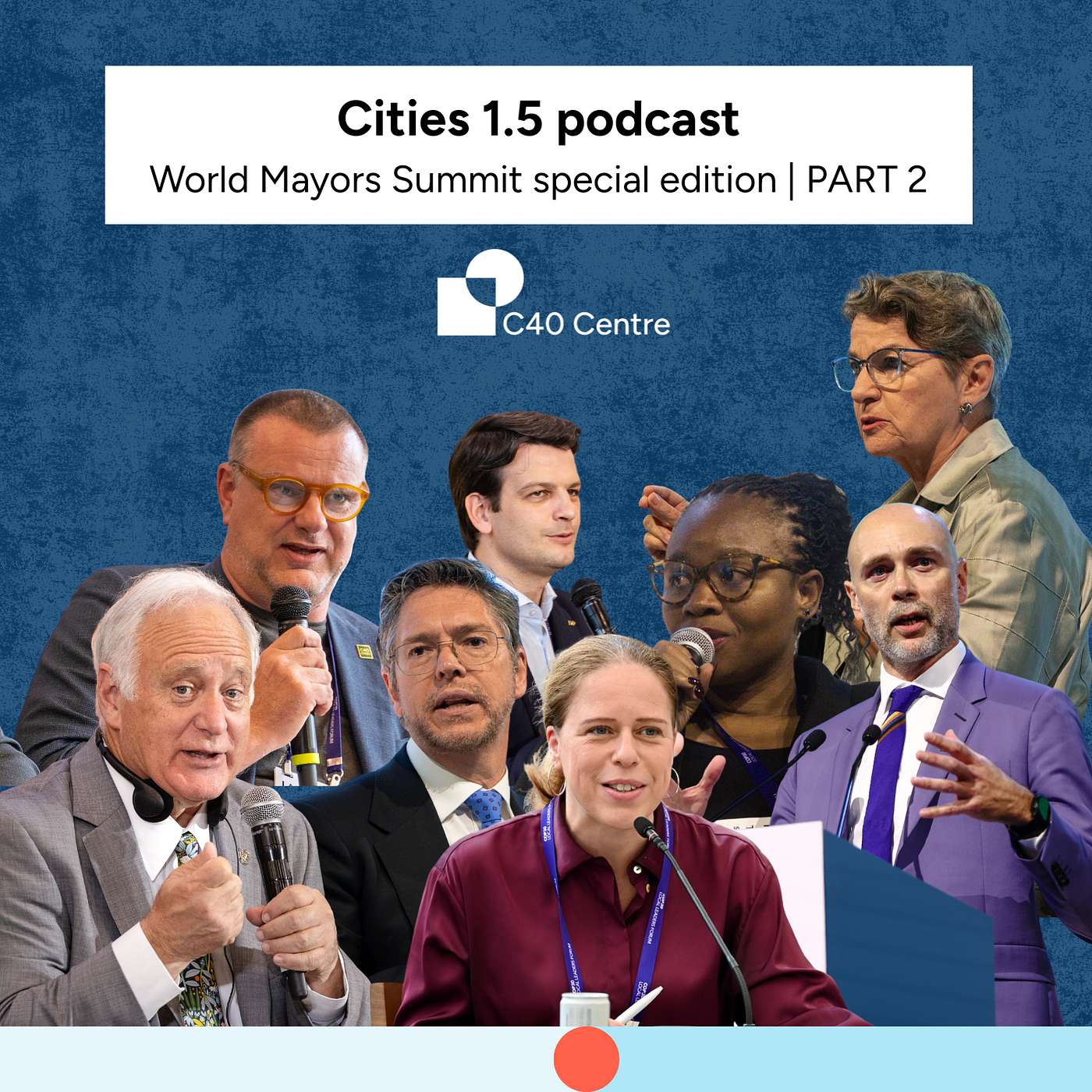
Inside the C40 World Mayors Summit: The battle for cities, truth, and a fossil-free future at COP30 and beyond
In the first episode of our two-part World Mayors Summit special, we heard from mayors around the world about the power of convenings like the Summit to unite city leaders and spark collaboration. In this second episode, we explore what that collaboration looks like in practice, from new approaches to urban planning and the challenge of energy-hungry data centres, to fossil-free trucks and greener

Inside the C40 World Mayors Summit: Cities throw down the gauntlet
In this first instalment of our two-part special from the C40 World Mayors Summit, Cities 1.5 takes you inside the flagship gathering of the world’s most ambitious urban climate leaders. We hear directly from mayors as they unveil this year’s Offer of Action – a unified commitment that raises the stakes for urban climate leadership and pointedly challenges national governments to match their ambit
TRAILER: Join us at the C40 World Mayors Summit
Cities 1.5 is back with a special two-part series focused on the C40 World Mayor's Summit in Rio de Janeiro, convening just ahead of the upcoming COP30 in Brazil. City mayors are continuing to play a critical role in combating climate change as they implement substantial climate policies and actions amidst the inaction of national governments. Tune in to hear behind-the-scenes discussions wit

Going Steady with Herman Daly: 'The seeds Herman planted'
We’re joining podcasts around the world in tandem with the 80th United Nations General Assembly, to ask a vital question: where do we find hope in challenging times? We explore how cities are implementing Herman Daly’s revolutionary economic theories.Featured in this episode:Karen Daly Junker, Herman and Marcia’s youngest daughterTerri Daly Stewart, Herman and Marcia’s eldest daughterDenis Daly He

Going Steady with Herman Daly: ‘¡No pasarán’/ É Proibido Proibir’
We follow Herman Daly into one of the last places you’d expect to find a rebel economist: the World Bank. We will hear how the academic work of Herman’s sister, Denis Daly Heyck, impacted on his worldview. We’ll also see how this fused with Herman’s own experiences teaching in Brazil, and the building of pan-American ecological and human rights movements to fuel him to advocate for policy and phil

Going Steady with Herman Daly: ‘For the common good’
We rejoin Herman Daly in the late 1970s - a tumultuous time for our renegade economist. Partnering with theologian John Cobb Jr., Daly began to rebuild economics from the ground up, reframing it around values, community, and the planet that sustains us.Woven through this intellectual journey are stories of faith, family, and friendship that helped Daly persevere. We hear how he sparked a global

Going Steady with Herman Daly: ‘The canary has fallen silent’
We follow Herman from the lecture halls of Louisiana to the forests of Brazil – and through a period of global upheaval and personal transformation. Herman was profoundly shaped by the realities of inequality and ecological fragility in the Global South. These experiences helped crystallize his vision of a steady-state economy; one that operates within the planet’s ecological limits and prioritize

Going Steady with Herman Daly: ‘There are limits to everything’
Herman Daly was a founding father of ecological economics: more than half a century ago, he warned that the pursuit of endless economic growth was driving ecological collapse and harming society, as well as harming society - and came up with a plan to unbreak our economy. Dismissed by mainstream economists, pushed out of the World Bank, and even targeted by menacing, anonymous threats, Daly paid a

TRAILER: Going Steady with Herman Daly: How to Unbreak the Economy (and the Planet)
Is it time to retire the concept of growth as the sole measure of prosperity? This summer, join host David Miller for a special miniseries dedicated to Herman Daly, an economist who transformed how we think about growth. Featuring never heard before interviews with Daly himself alongside experts, scholars, and Herman’s nearest and dearest, this is a story you won’t want to miss!The first episode o

TEASER - Going Steady: Happy Birthday, Herman Daly
Herman Daly would have turned 87 years old on July 21st, 2025. While he is no longer with us, his ideas have lived on - shaping an economic future that we haven’t yet achieved, but is steadily becoming the most probable way forward in the face of rising temperatures, extreme weather events, and ecological and economic decimation.But who exactly was Herman Daly? Why was his work scorned by the Worl

Knowledge is Power
For hundreds of years, people have been pondering the power of information. In this past season of Cities 1.5, we’ve seen examples of cities from around the world who are using data and the lived experiences of their inhabitants to create policies that support healthier lives for people and planet: from Freetown, Sierra Leone, to Tokyo, Japan, to Princeton, Canada. But while history - and our own

Brick by Brick: Cities and the future of clean construction
The building and construction sector is responsible for a mind-boggling 37% of global greenhouse gas emissions. The kinds of construction materials we use - and the building sector generally - are also responsible for almost a third of global resource consumption. Shifting to cleaner methods of construction is the only way to minimize the damage we are causing to the planet, while still providing

Why we need to adopt a Care Economy
Capitalism is an illness: it’s killing our planet, and by extension, us. Economic instability and environmental concerns are symptoms that can only be cured by redefining prosperity in terms of health and wellbeing, so that we can create sustainable, equitable societies. In his new book, The Care Economy, returning guest Tim Jackson dives into historical and systemic reasons behind our current eco

Resilient cities (and how to build them)
Cities around the world are on the frontlines of climate disaster. In Lisbon, Portugal, unprecedented flooding has required the construction of significant climate resilience projects like the city's drainage master plan. In the global south, cities like Ahmedabad, India are getting hotter and hotter…and the women who live in this region are disproportionately impacted physically and financia

Out of the frying planet and into the fire: Stories from the frontlines of climate-driven migration
As global temperatures and sea-levels rise, so to does the frequency of climate-driven migration. The search for a safe, healthy, and prosperous place to live has been a feature of humanity since time immemorial...but an increasingly polarized and toxic global discourse sees migrants being increasingly demonized, which makes it hard to have much-needed conversations around the issue. For many migr

Cities as Urban Laboratories: Time to re-think what prosperity really means?
As the world enters yet another period of unprecedented political and environmental tumult, it is becoming even more clear that our current economic system based on the primacy of profit over the health and wellbeing of people and planet is failing. Throughout history, cities have always been at the forefront of new ways of thinking, and are urban laboratories to test and pilot new concepts. The s

The Fate of the Inflation Reduction Act in the Second Era of Trump
The United States of America’s second withdrawal from the Paris Climate Accord under the Trump administration has enormous implications for both international and local climate efforts - and the Inflation Reduction Act is also potentially under threat. If the IRA is even partially repealed, it would be a huge step backwards in the fight against the climate crisis. But all is not lost - engaged ind

Risky business: How disinformation fanned the flames of the LA wildfires...and why insurance could help mitigate future climate impacts
Risk is an integral part of the human experience…but risk also needs to be managed if we are to live safe, healthy and happy lives. The recent wildfires in Los Angeles were a tragic reminder of the risks that the climate crisis poses to health, homes, habitats, and the lives of human beings. But the risks posed by extreme weather events are also multi-faceted: disinformation in the wake of hurrica

Dark Machines: AI, Climate Action, and the Future of Our Cities
We live in the age of technology…in the blink of an eye, the Internet and social media have created new opportunities, jobs, and possibilities for connection. But they have also fuelled polarization, persecution, and real-world violence. Artificial intelligence, or AI, promises to turbocharge this revolution. But many questions remain unanswered by the advocates of these new technologies. Can we a

Economic Power, Urban Change: Women who are leading the way forward
In times of uncertainty, leadership is key...but so is vision. As the climate crisis deepens, and people across the world are facing economic hardship and experiencing the increasing impacts of the climate crisis, mapping out an alternative to neoliberal economics, inequality and unmitigated climate breakdown has never been more vital. In our season opener, we speak to two women who are doing just

TRAILER - Cities 1.5: It’s Time to Speak Truth to Power
The world is standing on the brink…the deepening impacts of the climate crisis, rising inequality and increasing levels of economic turmoil are affecting us all. But we now face a new threat: a powerful network of autocrats, billionaires. and demagogues and fossil fuel industry leaders has emerged. This climate crisis denying coalition is weaponising disinformation and manipulating societal dis

How to protect people and planetary health: Lessons from the Peruvian Andes and New Orleans
In this final episode of Season 4 of Cities 1.5, David has conversations with two formidable and inspiring women who are fighting to protect the health of people and the planet from Lima, Peru and New Orleans, USA. As the impacts of the climate crisis hit harder and more frequently, the effects this has on human health also multiply. It is key that urban areas plan and adapt to meet the growing ch

Fighting for a Biodiverse Future: How Canadian climate leaders are preserving ecosystems from their own backyards
In a very Canadian episode of Cities 1.5, David discusses the urgent need for both local and global climate action with a focus on biodiversity with Mayor Valérie Plante of Montréal and Elizabeth Hendricks from the World Wide Fund for Nature (WWF) Canada. They share insights on urban biodiversity initiatives, the impact and outcomes of COP15 and COP16, and the importance of integrating nature-base

C40 x UN Live: Portals to a flourishing world
In this episode of Cities 1.5, David revisits and follows up on a very special collaboration between C40 and Museum for the United Nations - UN Live which he participated in during the Summit of the Future and Climate Week in New York in early autumn, 2024. David, along with Sasha Rodericks and Kayla Archer share their reflections on the power of cross-cultural and cross-sectoral communication in

How to protect people and planet from misinfluencers in the Age of Disinformation
In this episode of Cities 1.5, David Miller speaks with Pragyna Senapati of Ripple Research about the pervasive impact of climate-related dis- and misinformation. In the past few years, false narratives have been pushed around climate issues in an attempt to derail the policies the world needs to protect the health of people and planet. Ripple has carried out extensive research of these misleading

The pan-African transition from fossil fuels to clean energy
In this episode of Cities 1.5, David speaks with two urban climate leaders about the critical issue of energy access in Africa. Despite Africa's low contribution to global emissions, the continent faces a rising energy demand that necessitates a transition to renewable energy in order to ensure its accessibility for all. The fossil fuel industry has a devastating legacy across the African con

Extreme Heat: The Silent Killer
Extreme heat has a profound impact on human health - and the health of the planet, and all who live on it. In this episode, we hear firsthand accounts of extreme heat impacts from Cities 1.5 listeners around the world in Calgary, Canada, Athens, Greece and Rio de Janeiro, Brazil and delve into the terrifying effects of rising temperatures on daily life - such as disease outbreaks and threats to vu

There’s no place like home...
In this episode of Cities 1.5, David Miller and his expert guests explore the multifaceted global housing crisis, as well as its ties to the climate crisis and the health of people and planet. Featuring personal stories and case studies from diverse regions that range from Toronto, to Colombia, to Gaza, we hear how cities around the world are advocating for housing as a human right, and delve into

What does a good life mean for you?
In this episode of Cities 1.5, David and his guests from countries on opposite sides of the equator, South Africa and Scotland, explore how urban initiatives are transforming local communities through holistic climate action and wellbeing practices. Linear economic systems - previously the global status quo - have been proven time and again to be ineffective at prioritizing wellbeing for all…espec

What is the climate crisis doing to our bodies and brains?
This episode delves into the intersection of the climate crisis and public health, with a particular emphasis on how the former is impacting on our bodies and our brains. Conversations with both featured guests explore how climate change exacerbates traditional health issues and introduces new risks, such as the increasing range of vector-borne diseases and what that means for the future of health

A cwtch for the planet and future generations
In this episode of Cities 1.5, host David Miller speaks with Sophie Howe, the world's first Future Generations Commissioner about her role and the landmark Wellbeing of Future Generations Act - legislation passed by the Welsh government which aims to improve the environment, economy, society, health and wellbeing of Wales and its people, both now and for future generations. They discuss the c
TRAILER - Cities 1.5 Season 4: Our Planet is Sick
The climate crisis is making both the planet and its inhabitants critically ill - and it's also amplifying public health issues and creating new ones, especially in urban areas. With over 65% of the world's population projected to live in cities by 2050, it is crucial that city governance integrates emerging research on climate health impacts. Season 4 of Cities 1.5 will feature conversa
TRAILER - Cities 1.5: The Clock is Ticking
In 2016, the Paris Agreement was adopted by 194 national governments and the EU with the aim of limiting global heating to 2 degrees Celsius above pre-industrial levels. Experts warn that exceeding this limit will result in catastrophic climate impacts...and while many nations hesitate, cities around the world are taking action to combat the climate crisis. Season 4 of Cities 1.5 returns October 8

Lessons in Wellbeing Economics: Engaging local communities to bring Academic Principles into Urban Practice
This past January, our editorial counterparts at the the Journal of City Climate Policy and Economy published an issue dedicated to Ecological Economics; this episode showcases two experts in wellbeing economics who contributed their knowledge to that edition.Image Credit: Photo by Milly Vueti on UnsplashFeatured guests:Amanda Janoo is the Economics & Policy Lead at the Wellbeing Economy Allia

Building our way to a cleaner planet: How cities are leading the way
Energy consumed by buildings accounts for almost half of cities’ carbon emissions on average. Because buildings can last over 100 years, increasing their energy efficiency is critical if we are to meet our current global climate goals. To achieve these goals, cities must transition fossil fuels out of their buildings.Image Credit: Tristan CapacchioneFeatured guests:Frankie Downy is the Head of Bui

Arctic impacts: The human cost of melting ice
Last episode of Cities 1.5, we took you into the Arctic region through the perspectives of a world-renowned scientist and seasoned canoeist and river guide. This time, we’re staying in that region - but we’re speaking to an expert who hails from the circumpolar North about the connections between climate change and human rights. Because Indigenous communities have been calling attention to warming

Arctic impacts: Knowledge from the north
The Arctic is heating at four times the rate of the rest of the planet, and is a key indicator region for mapping the impacts of the climate crisis. Glacial melt is predicted to contribute to disastrous rates of sea-level rise which will have catastrophic impacts on global cities, coastal communities and the millions of people who live there. It is crucial that we do everything we can in our citi

Solved: How the World’s Greatest Cities Are Fixing the Climate Crisis
Cities 1.5 Host David Miller’s book Solved: How the World’s Greatest Cities Are Fixing the Climate Crisis has just been released to paperback in a revised version and with an all new chapter just in time for World Book and Copyright Day! In it, he chronicles the stories of cities who have taken action to meet - and exceed - the emissions targets laid out in the Paris Agreement to transition away f

Fighting fossil fuels: Decarbonising cities with data mapping
By 2035, global fossil fuel use must be reduced to 50% of 2020 levels - or else we will face uncertain and serious consequences. But the fossil fuel industry keeps forging ahead, making billions at the expense of all of us, through attempts to re-brand fossil gas as a clean energy alternative, using disinformation narratives to delay and deceive, and advocating for the building of new fossil fuel
TRAILER - Introducing Solved: How the World’s Great Cities Are Fixing the Climate Crisis
Next time on Cities 1. 5, it's a special takeover episode! Acquisitions Editor at University of Toronto Press, Jodi Lewchuk, interviews David about his book, Solved: How the World's Great Cities Are Fixing The Climate Crisis. Solved has just been released in paperback this week with an all-new chapter.David will be at the University of Toronto Bookstore on Wednesday, April 17th to celebr

Funders Focus: Philanthropic efforts that are driving the fight against climate breakdown
Cities stand on the frontline of the climate crisis - so they must also work to create frontline policies that support the global systems change required to ensure that cities have a future. Thanks to philanthropic support from both Global North and Global South organisations, the scientists, artists, and community leaders around the world who are making a climate-assured future possible are ensur

Disinformation thrives in times of crisis
Efforts to address the climate crisis are under siege beneath a rising tide of mis- and disinformation, with smear campaigns often funded and coordinated by vested interests such as the fossil fuel industry, climate conspiracists looking for cash and clicks, and even national governments. We all have a part to play - we must take responsibility for the information we consume and share to ensure a

Do we all breathe the same air?
Being able to breathe clean air should be a human right but, according to the World Health Organization 99% of the world’s population lives in areas exceeding safe pollution limits, which has huge impacts on public health. Air pollution, climate impacts, and social justice are three sides of the same issue, demanding an intersectional response that not only makes space for the voices of the most i

Herman Daly’s Great Debates: The enduring vitality of Ecological Economics
Ecological economics lies at the heart of the Journal of City Climate Policy and Economy and C40’s mission. It recognises that the former gold standard of measuring economic success – the growth of gross domestic product, or GDP – is no longer fit for purpose, despite the fact that it’s the model that most national governments still rely on. Policies that allow us to prioritize the vitality of bot

Last-minute pledges and sobering science: Where is the World, Post-COP28?
Last year's COP28 conference ended with a historic first: after dramatic and tense negotiations lasting deep into the night, representatives from across the globe agreed upon a roadmap to transition away from dirty energy. But does the agreement fall short of what is required if the world is to avoid breaching crucial and deadly climate tipping points? Image Credit: © Maurizio Martorana - C4

Why Women are Saving the Planet
The UN Women slogan for International Women’s Day 2024 is “Invest in women: Accelerate progress,” and in support of this goal we’re opening Season 3 of Cities 1.5 with a production team takeover! David Miller may be the voice of the podcast, but our amazing production team is all female. Also, we hear from two amazing women who are working to ensure that women’s voices are heard, mainstreamed and
TRAILER - Cities 1.5 Season 3: Our Post-COP World & Beyond
This past December, COP28 signalled the beginning of the end of the fossil fuel era. 150 heads of state came to the consensus that in order to halve emissions by 2030 - the target that scientists have warned us be must adhere to in order to avoid climate catastrophe - we must transition away from dirty energy. This is a monumental moment for our planet…and cities are going to be leading the way as

From global warming to global boiling: The dangerous present & future of the world’s climate
The Intergovernmental Panel on Climate Change (IPCC) has been warning us for decades that record-breaking, hot, fire- and smoke-filled summers like the one we just experienced will continue to be the new normal without huge and immediate cuts in global greenhouse gas emissions. The latest IPCC report serves as our last warning: carry on as we are and we’ll face ever-increasing extreme climate even

Camino de Ecologia: Latin American Cities Innovating to Save the Planet
In the face of enforced mass migration, the rising cost of recovery from increasing climate disasters, and an uncertain future without drastic and immediate action, it’s important to hold up examples of cities and projects that are successful in their innovative climate actions. In this episode, we look at climate projects in Curitiba, Brazil, and Barranquilla, Colombia, that are working towards s

A Tale of Two Cities: A Global North & South Case Study in Resilience
“It was the best of times, it was the worst of times”: the first line of the Charles Dickens novel A Tale of Two Cities is an idea that the two cities featured in this episode’s case study know all too well. The Global South’s Nairobi, Kenya and the Global North’s Rotterdam in the Netherlands are half a world apart, but they’re each facing similar and equally dire climate consequences that are cau

Planting 1 million trees to turn the temperature down: How cities in the Global North and South are battling extreme heat
July 2023 was the hottest month globally since records began. Combine that with several months filled with a series of extreme weather events - from heatwaves in Europe, North America and Asia, to wildfires in Canada and Greece - and it’s undeniable that the impacts of climate change that experts have long been warning us about are here today. And the worse news is that it’s only going to get hott

How Cities can Divest
Climate breakdown is happening, and the cost of ignoring this phenomenon will be far greater than the cost of immediate action. We know that green investments promote the transition to a more resilient, prosperous, and sustainable economy. But what are the steps that cities need to take in order to shift their investments away from fossil fuels? How can policy makers support the creation of good,

Beyond Growth: How cities can put people and planet first
C40 and the Journal of City Climate Policy and Economy are providing an opportunity for cities to rethink conventional economic systems, like capitalism, that have led to the climate crisis. It is abundantly clear that the economic rules and systems created after WWII have led to twin crises: climate change and continued inequality. It’s necessary to unpack these theories to better understand thei

Neoliberalism and its Discontents: Is Ecological Economics the Answer?
The traditional economic concepts that the Global North has been using since WWII assume that there is an infinite planet and that pollution has no economic consequences - assumptions that are wildly wrong. In contrast, ecological economics is a model designed to respect the fact that our economy exists on a finite planet and puts more emphasis on the quality of economic activity than its quantity

Climate communications: How to shift the narrative?
In this episode, we discuss what cities can do - and are already doing - to combat climate change, while also considering how cities can communicate these policies. Communication means exchanging and listening to ideas; and in the climate context, to fight back against the propaganda of the fossil fuel industry, far-right political movements and online conspiracy theorists. Mayors and governments

How Cities Can Strive for Climate Justice and Resilience
Striving for Climate Justice and Resilience is one of the most important goals at the Journal of City Climate Policy and Economy and C40 Cities. The forthcoming Volume 2.3 of the journal will be dedicated specifically to climate justice and resilience because the people and places least responsible for the problem are the ones who often bear the largest burden, and cities need to be doing their pa

Live at London Climate Action Week: Public Transport x Good Green Jobs
There’s a crucial link between good green jobs and public transport - in London, and around the world. This episode features a live podcast conversation that was organised by C40 Cities and the International Transport Workers Federation and recorded at London Climate Action Week in June 2023. Inspired by the mission of delivering a fair, inclusive, and just climate transition, this session titled

How Cities can Climate Budget
As we aim toward a 1.5 degree future, we need to fundamentally shift the way we lead our cities. One substantial change is that cities need to look to a new form of governance - one that places climate action at its heart. A critical tool for cities is a climate budget: a governance system that offers a way for cities to turn climate commitments into funded and measurable actions across their gove